
We earn a commission if you buy through these links. Learn more
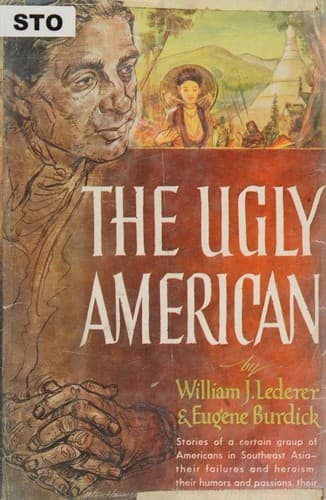
The Ugly American
by William J. Lederer, Eugene Burdick
A sharp, short Cold War novel of linked episodes that shows how American diplomacy and everyday engineering can succeed or fail abroad, and that gave a phrase to the language.
What It's About
The Ugly American is a 1958 political novel built from linked episodes rather than a single plot. It follows a group of American diplomats, military men, and aid workers in a fictional Southeast Asian nation called Sarkhan, where a communist insurgency is gaining ground and Washington is struggling to respond. Chapters shift between viewpoints, and the book's most memorable figures are those who try to understand local people instead of lecturing them.
The style is blunt, reportorial, and deliberately argumentative. Co-author William Lederer was a Navy officer and Eugene Burdick was a political scientist, and the book reads more like a set of case studies with a clear thesis than a character-driven literary novel. Dialogue often carries the point, and the sketches are sharp rather than deep. Expect meetings, speeches, and policy arguments as much as action.
The experience is quick and provocative. It is short enough to finish in an evening or two, yet it keeps pushing you to argue with it. Its central question, how representatives of one country should live and work among the people they hope to influence, still feels pointed, even though the particular politics it addresses belong to a distant era.
Read this if you…
- are curious how Cold War Americans thought about foreign policy and diplomacy
- enjoy short, direct books that read almost like case studies with a point of view
- want a classic that helped shape a lasting phrase in American public life
Skip it if you…
- want a character-rich novel with subtle prose and a satisfying plot arc
- prefer fiction that treats foreign cultures with nuance and complexity
Key Ideas
- 1
Influence depends on understanding local people
The book's strongest argument is that foreign representatives who learn the language, customs, and daily concerns of the people they work with accomplish far more than those who arrive with fixed assumptions and an air of superiority. Much of the narrative contrasts these two approaches in concrete situations.
- 2
Practical solutions beat grand gestures
Several storylines celebrate modest, inexpensive, locally workable fixes over large, showy projects. The authors suggest that small, well-chosen engineering and aid efforts can win more loyalty than expensive programs designed far away and imposed from above.
- 3
Bureaucracy as a barrier to effective action
The novel portrays government agencies that are slow, status-conscious, and more concerned with appearances than results. This theme of institutional inertia gives the episodes a shared frustration and drives much of the tension between field workers and headquarters.
- 4
Cold War anxiety shaping every choice
Fear of communist expansion runs through the book and colors the judgments of its characters. Reading it today, you see the era's assumptions as a lens on the moment, which is part of what makes it useful as a historical document of Cold War thinking.
Limitations
The book is widely criticized for its portrayal of Southeast Asian people, who often appear as passive or as stock types rather than as full characters. Its anti-communist framing is heavy-handed, and critics argue it simplifies complex political realities into lessons about American virtue. The characters are thin, the structure is episodic, and the policy assumptions reflect the late 1950s. Its well-known phrase has also been used more loosely than the book itself intended.
Questions Readers Ask
- Is The Ugly American still worth reading today?
- Yes, mainly as a window into Cold War thinking and as the source of a phrase still in common use. As a guide to Southeast Asia or to modern foreign policy, it is dated. Read it with historical context and you will learn more from its blind spots than from its conclusions.
- How does it compare to Graham Greene's The Quiet American?
- Greene's novel is far more literary, with ambiguous characters, layered prose, and a melancholy tone. The Ugly American is blunter, more episodic, and openly polemical. If you want a deeper and more critical look at the same era and similar subject, Greene is the stronger choice.
- Published
- 1958
- ISBN
- 9780449204658
- Difficulty
- beginner
- Category
- Fiction
Book details and cover from Google Books.
Ready to read The Ugly American?
Get your copy on Amazon, or listen to it on Audible. We earn a commission if you buy through these links.