
We earn a commission if you buy through these links. Learn more
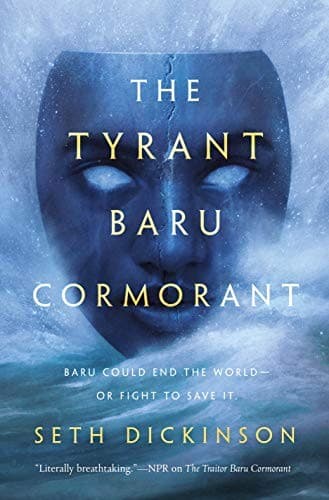
The Tyrant Baru Cormorant
A morally tangled political fantasy about a brilliant numbers mind working from inside an empire's machinery, where every compromise has a price the reader feels.
What It's About
The Tyrant Baru Cormorant is the sequel to The Traitor Baru Cormorant, and it reads best as the continuation of a long, patient plan rather than a standalone novel. Baru is a gifted economist and administrator who has spent years inside the Empire of Masquerade, learning how a vast state runs on tariffs, debts, and ledgers. Dickinson writes her as someone who thinks in systems, so much of the tension comes from watching her weigh costs that other characters would never bother to count.
The style is dense, deliberate, and often cold on the surface. Scenes tend to revolve around negotiations, bargains, and the arithmetic of power, and the prose can be precise to the point of severity. Dickinson does not offer easy villains or clean heroics. He keeps returning to what it costs to be effective inside a machine you despise, and violence tends to land hard when it arrives, precisely because the book has spent so long on patience and planning.
Reading it is demanding but rewarding for the right person. You will get more out of it if you remember the first book's setup, and you should expect to slow down for the political detail. It suits readers who enjoy moral complexity and fantasy that takes economics seriously, and who would rather watch a long game unfold than follow a quick adventure.
Read this if you…
- enjoy political fantasy where strategy and negotiation drive the story
- want a protagonist whose moral choices are genuinely hard to judge
- are curious how economics and empire work and like seeing them dramatized
Skip it if you…
- want fast-paced action or a steady stream of set-piece battles
- prefer clear heroes and villains and find ambiguity frustrating
Key Ideas
- 1
Power that runs on accounting
The book treats empire as a financial system first. Taxes, debts, and trade terms are shown as the real instruments of control, and the reader sees how quiet bookkeeping can shape lives more than armies do. This gives the political plot a grounded, unusual texture that many fantasy novels lack.
- 2
Complicity as the central dilemma
Baru's problem is not simply how to defeat the empire but how to act within it without becoming it. The book keeps pressing on the gap between personal integrity and effectiveness, asking whether a good goal can justify methods that corrode the person pursuing it.
- 3
A protagonist defined by calculation
Baru's cleverness is her defining trait, and the storytelling follows her reasoning closely. Readers are invited to model her choices and judge them, which makes the book feel more like an intellectual puzzle than a conventional quest, and it rewards close attention.
- 4
Colonial history and its afterlives
Beneath the plot sits a critique of imperial domination and the way conquered peoples are managed through debt and dependence. Dickinson uses the fantasy setting to examine these dynamics directly, without reducing them to a simple allegory of any single real-world empire.
Limitations
Some readers find the book slow, since much of it is planning, conversation, and internal calculation rather than action. The density of political and economic detail can be tiring, and the cool, controlled prose may keep emotional connection at arm's length for some. Because it continues a larger story, it also depends heavily on the first book, and newcomers who skip that setup will likely feel lost. The moral darkness is deliberate, but readers who want a more hopeful arc may find it bleak.
Questions Readers Ask
- Should I read The Traitor Baru Cormorant first?
- Yes. This book is the sequel and assumes you know Baru's background, the Empire of Masquerade, and the plan she set in motion. Starting here would leave you without the context needed to follow the political maneuvering and the weight of her choices.
- Is this a good pick for fans of grimdark or political fantasy?
- It suits readers who like political fantasy with morally compromised characters, though it is less about graphic brutality than about the ethics of power. If you enjoy complex scheming and institutional conflict, you will likely find it satisfying. If you want relentless action, it may feel too deliberate.
- Published
- 2020
- ISBN
- 9780765380777
- Difficulty
- advanced
- Category
- Fantasy
Book details and cover from Google Books.
Ready to read The Tyrant Baru Cormorant?
Get your copy on Amazon, or listen to it on Audible. We earn a commission if you buy through these links.