
We earn a commission if you buy through these links. Learn more
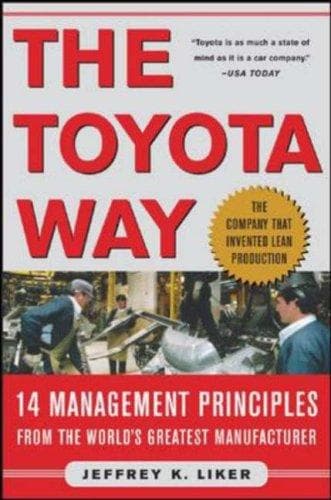
The Toyota Way
Guide by the Books of the Day editors · Updated · How we write our guides
A clear, well-organized account of the management habits behind Toyota's production system, useful for anyone who wants to understand lean thinking beyond its tools.
What Creators Say About The Toyota Way
2 creators reviewed The Toyota Way on YouTube between 2021 and 2022, with 70.6K views between them. Their opinions are their own; we picked these reviews, we didn't write them.
What It's About
The Toyota Way is Jeffrey Liker's attempt to describe what sits underneath Toyota's manufacturing reputation: not the famous tools alone, but the management system and habits of thought that produced them. Liker spent years observing Toyota plants and studying its practices, and he organizes what he found into fourteen principles grouped under four headings: philosophy, process, people and partners, and problem solving. The structure moves from the long view of why a company exists, through how work flows, to how people are trained and how problems get solved.
The approach is more descriptive than prescriptive, though it does plenty of translating. Each principle comes with an explanation, examples drawn from Toyota and from its plants and suppliers, and practical notes on what the idea looks like on a factory floor. Liker repeatedly stresses that tools such as kanban or andon signals only work when they sit inside a culture of respect and continuous learning, and he is blunt about the gap between copying practices and understanding them.
Reading it feels like a long, careful walk through a well-run plant with a guide who keeps pointing out why things are where they are. It is dense in places and repeats its core messages, which some readers will find reinforcing and others tedious. The book rewards patience and a willingness to think about your own workplace while you read.
Read this if you…
- want a grounded explanation of how Toyota's production system fits together, not just a list of tools
- run or work in operations and want to understand why lean practices often fail when copied piecemeal
- are interested in management culture and how leaders build problem-solving habits across a team
Skip it if you…
- want a quick how-to guide with templates and step-by-step implementation plans
- work far outside manufacturing and need examples that map directly onto software, services, or healthcare
Key Ideas
- 1
Long-term philosophy over short-term numbers
Liker argues that Toyota ranks purpose and long-term payoff above quarterly results, and that good process outcomes follow from that orientation rather than being chased directly. The point is that financial targets shape behavior, so the underlying goals need to be chosen with care before anything else is measured.
- 2
Surface problems by making flow visible
Toyota designs its processes so that problems show up quickly: work is pulled rather than pushed, inventory is kept low so it does not hide defects, and workers are empowered to stop the line. The idea is that a problem you cannot see cannot be fixed, so the system is built to expose weaknesses early.
- 3
Go and see for yourself
Known in Japanese as genchi genbutsu, this principle holds that decisions should rest on direct observation at the place where work actually happens. Managers are expected to learn by walking the floor rather than relying on summaries, which Liker presents as a discipline that keeps leaders honest about what is really going on.
- 4
Grow people who understand the work
Liker describes Toyota's emphasis on developing leaders who know the details of their processes, building strong teams, and treating suppliers as an extended network. Respect and mutual improvement run in both directions, and the book makes the case that people capability is as important as any production method.
- 5
Continuous improvement as an everyday habit
Standardized work is treated as the baseline from which kaizen, or incremental improvement, begins. Reflection and learning are built into daily routines so that the organization keeps getting better without relying on occasional large initiatives or outside consultants.
Limitations
The book is written in a generally admiring voice and can read as a tribute, with less attention to Toyota's failures or to the criticisms its methods have drawn. The major 2009 and 2010 recall problems and the debate about how much of the model depends on Toyota's unusual culture came after publication, so the book does not address them. It is strongly focused on manufacturing, and translating its ideas to other settings takes real work. Some sections repeat the same points, and the Japanese terminology adds a learning curve.
Questions Readers Ask
- Is The Toyota Way still relevant?
- The core ideas about flow, visible problems, and respect for people have held up well, and many organizations still use the language of lean. The specific examples and company details are dated and Toyota has changed since publication, so treat the case material as a snapshot of a particular era rather than a current guide to the company.
- How does it compare to The Machine That Changed the World?
- The Machine That Changed the World by Womack, Jones and Roos is the earlier book that brought the term lean to a wide audience, and it focuses on the history and economics of the auto industry. Liker's book goes deeper into the internal management system and daily habits, so it is more practical for someone already running operations.
- Published
- 2004
- ISBN
- 9781932378702
- Difficulty
- intermediate
- Category
- Business
Book details and cover from Google Books.
Ready to read The Toyota Way?
Get your copy on Amazon, or listen to it on Audible. We earn a commission if you buy through these links.