
We earn a commission if you buy through these links. Learn more
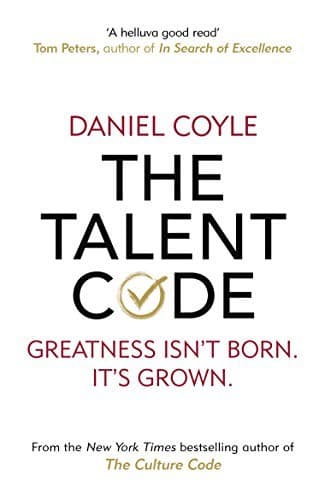
The talent code
by Daniel Coyle
A journalist's tour of how skill really develops, from elite training grounds to the brain's wiring, that replaces the myth of innate talent with a practical way to practice.
What It's About
The Talent Code is a popular science book that asks why some groups produce an unusual number of world-class performers and what they do differently. Coyle, a journalist, travels to places known for producing elite athletes and musicians, then interviews coaches, teachers, and researchers to piece together an answer. The book is built as a series of reported scenes and profiles rather than a textbook, so each idea arrives attached to a person, a place, or a training session.
The central argument is that talent is less a fixed gift than a product of how practice is structured. Coyle focuses on what happens when learners push at the edge of their ability, make errors, and receive precise feedback, and he connects those experiences to the way the brain builds insulation around frequently used circuits. He also explores how coaches send signals that motivate students to keep going. The science is presented in plain language and kept mostly in service of the stories.
Reading it feels like sitting in on a long conversation with a curious, observant reporter. It is quick, vivid, and easy to follow, and it works best as a source of fresh ways to think about learning a skill, whether you play an instrument, coach a team, or simply want to get better at something difficult.
Read this if you…
- want practical ideas for improving how you practice a skill
- coach, teach, or parent young learners and want fresh approaches
- enjoy narrative nonfiction that mixes reporting with ideas about learning
Skip it if you…
- want a rigorous scientific account of motor learning or neuroscience
- are looking for a step-by-step training plan for a specific sport or instrument
Key Ideas
- 1
Talent as a product of practice
The book's core claim is that high performance is built rather than born. Coyle argues that the difference between talented and ordinary performers often lies in how their time is spent, especially in the quality and intensity of practice rather than the quantity of hours logged. This reframing matters because it shifts attention from who people are to what they do repeatedly and deliberately.
- 2
Deep practice and the edge of struggle
Coyle describes practice that stretches a learner just beyond current ability, where mistakes are frequent and corrected quickly. He contrasts this with comfortable repetition that feels productive but changes little. The useful takeaway is a test you can apply to your own sessions: if practice feels easy and smooth, it may not be doing much for you.
- 3
The role of myelin in skill
Coyle explains that skills become fluid as the brain wraps frequently used nerve pathways in a fatty insulation that speeds signals. He uses this idea to explain why slow, focused repetition builds lasting ability. The science is simplified for a general audience, so treat it as a useful metaphor for how practice changes the brain rather than a complete account of learning.
- 4
Coaching cues and the drive to continue
Much of the book looks at the small signals that teachers and coaches send, including brief, pointed messages that make a learner feel valued and connected to a larger purpose. Coyle suggests these moments can ignite persistence in a way that instruction alone cannot. Readers who coach or teach will find concrete ideas here about how to give feedback that actually sticks.
Limitations
Critics have pointed out that the book leans on anecdotes and striking examples, which makes its conclusions feel more settled than the research supports. The myelin discussion is a simplified metaphor rather than a detailed neuroscience account, and some readers find the sweeping claims about talent hotbeds overstated. The book also gives little attention to the role of genetics, luck, body type, and access to resources, which shape outcomes in ways it does not fully explore. Read it as an inspiring starting point rather than a final word on expertise.
Questions Readers Ask
- Is The Talent Code still worth reading today?
- Yes, mainly for its practical framing of deliberate, error-driven practice and the idea that skill is built rather than inherited. Some of the neuroscience is dated or simplified, so pair it with more recent research on learning and expertise if you want the current scientific picture.
- How does The Talent Code compare to Peak by Anders Ericsson?
- Peak focuses more tightly on the research behind deliberate practice and is more methodical about evidence. The Talent Code is more narrative and travels to specific places and coaches. If you want rigor, choose Peak; if you want stories and a readable overview, The Talent Code is the easier introduction.
- Published
- 2009
- ISBN
- 9780099519850
- Difficulty
- beginner
- Category
- Self-Improvement
Book details and cover from Google Books.
Ready to read The talent code?
Get your copy on Amazon, or listen to it on Audible. We earn a commission if you buy through these links.