
We earn a commission if you buy through these links. Learn more
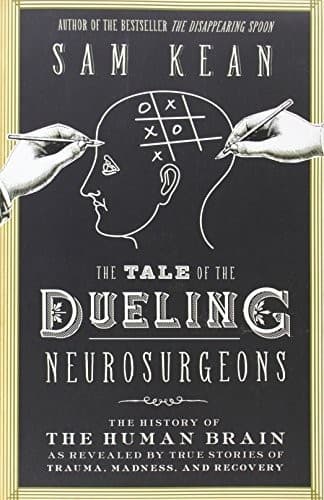
The Tale of the Dueling Neurosurgeons
by Sam Kean
Guide by the Books of the Day editors · Updated · How we write our guides
A lively, anecdote-driven tour of how the brain was mapped through injuries, surgeries and odd disorders, written for readers who want the human stories behind neuroscience.
What Creators Say About The Tale of the Dueling Neurosurgeons
1 creator reviewed The Tale of the Dueling Neurosurgeons on YouTube in 2014, with 268 views between them. Their opinions are their own; we picked these reviews, we didn't write them.
What It's About
The Tale of the Dueling Neurosurgeons is a popular history of the brain told through case studies. Its chapters center on people whose brains were damaged by accidents, disease, surgery, or unusual wiring, and on what those cases revealed about how different regions of the brain work. Sam Kean, a science writer known for narrative nonfiction, uses each vivid episode as an entry point and then explains the biology behind it in plain language.
The approach moves back and forth between a single gripping story and the wider history of how doctors and researchers came to understand a given function. The title story points to a larger theme: the field of brain surgery was shaped by ambition, rivalry, and trial and error as much as by careful method. Kean's tone is conversational and playful, with asides, jokes, and digressions that keep the science from feeling heavy.
Reading the book feels more like working through a set of linked magazine features than a textbook. You finish with a rough map of major brain regions, a clearer sense of why damage to one area can change memory, language, or personality, and an appreciation for how little anyone understood until surprisingly recently. Pacing varies from chapter to chapter, and some sections are denser with anatomy than others.
Read this if you…
- enjoy true stories about medical oddities and their scientific payoff
- want a friendly introduction to brain anatomy without equations or jargon
- like history told through personalities, feuds, and near misses
Skip it if you…
- want a rigorous, up-to-date survey of current neuroscience research
- prefer a dry, citation-heavy academic style or a structured textbook
Key Ideas
- 1
Damage as a window into function
Many of the book's most important discoveries came from injuries rather than laboratory experiments. When a specific area was damaged and a particular ability disappeared, researchers could infer what that area normally did. Kean shows how these accidents, often grim, became the foundation for mapping the brain, and how clinicians learned to read the signs of damage with growing precision.
- 2
Medicine shaped by rivalry and ambition
Early brain surgery was a competitive field, and personal feuds, public reputations, and bold experiments influenced what got tried and who got credit. The book treats these human dynamics seriously, showing that scientific progress in neurology depended on people with strong opinions, sometimes working at cross purposes, as much as on tidy evidence.
- 3
Recovery and the brain's plasticity
Some of the most striking stories concern patients who regained abilities after serious injury, sometimes because other regions took over lost work. These cases challenge the old assumption that the brain is a fixed machine with rigid parts. Kean explores what recovery reveals about adaptability, and where that adaptability has limits.
- 4
Mind, identity, and the physical brain
Cases of personality change, memory loss, and disorders of perception raise questions about what the self is made of. By tying dramatic symptoms to specific physical changes, the book makes a persuasive case that thoughts, emotions, and character depend on tissue that can be hurt, repaired, or misunderstood. It leaves readers with a more concrete sense of how fragile and tangible the mind is.
Limitations
Because the book is organized around stories, some topics are covered briefly and others get more space than their scientific importance might justify. Readers looking for the latest findings on topics like brain imaging, neural networks, or treatment advances will find the material dated, since the book was written over a decade ago. Some critics find the jokey tone and frequent asides distracting, and the storytelling sometimes outruns the evidence. It is best read as a gateway to the field rather than the final word on it.
Questions Readers Ask
- Who is this book best suited for?
- It suits general readers curious about the brain who enjoy narrative nonfiction and don't mind a playful voice. No background in biology is needed, since Kean explains the anatomy as he goes. Readers who want a systematic course or the newest research should look for a more recent survey or a textbook-style title.
- Is the science still relevant?
- The core lessons about how injuries and disorders reveal brain function remain valid, and the historical stories are still engaging. However, specific technical details and treatment options have moved on considerably. Treat the book as a solid historical and conceptual introduction, then pair it with a newer overview for current findings.
- Published
- 2014
- ISBN
- 9786055029531
- Difficulty
- beginner
- Category
- Psychology
Book details and cover from Google Books.
Ready to read The Tale of the Dueling Neurosurgeons?
Get your copy on Amazon, or listen to it on Audible. We earn a commission if you buy through these links.