
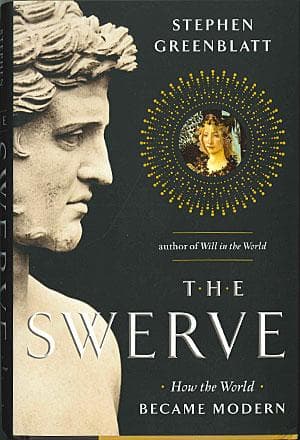
We earn a commission if you buy through these links. Learn more
The swerve
A lively, well-told account of how a forgotten Roman poem about atoms and pleasure was rediscovered and quietly reshaped the Renaissance mind.
What It's About
The Swerve is Stephen Greenblatt's account of how a Roman poem nearly vanished, and how a book hunter's find in 1417 helped release ideas that had been largely sidelined for centuries. The poem is Lucretius's On the Nature of Things, a long work about atoms, a universe without divine meddling in human affairs, and the case for living without fear of death. Greenblatt follows the manuscript's rediscovery by Poggio Bracciolini, a papal secretary who searched monastery libraries for forgotten classics.
Much of the book is narrative, moving between Poggio's searches, the copying and circulation of the text, and the people who read it and argued about it. Greenblatt is a literary scholar, and he writes like one: he pays attention to style, to the physical life of manuscripts, and to the way an argument travels through a culture. The tone is warm and conversational, closer to a long essay than a textbook. You will learn a fair amount about Renaissance debates over pleasure, mortality, and the nature of the cosmos, but the reading experience feels like following a detective story whose clues are old letters and copied texts.
The result is less a technical history of philosophy than a story about how ideas survive by chance and get reinterpreted. Readers expecting a tidy argument about science or technology may find the scope looser than the title suggests. Readers who enjoy intellectual history told through people will find it rewarding.
Read this if you…
- are curious about how classical texts survived and reached the modern world
- enjoy narrative nonfiction with a literary, character-driven pace
- want an accessible entry point into Epicurean and Renaissance thought
Skip it if you…
- want a rigorous academic argument with full scholarly apparatus
- were hoping for a book about technology or the modern history of science
Key Ideas
- 1
Texts survive by accident and persistence
Greenblatt shows that what we know of the ancient world depends on which manuscripts happened to be copied, stored, and forgotten. Monastery libraries, scribes, and a few determined collectors decided what got through. The book makes the fragility of the written record feel concrete and a little alarming.
- 2
Atoms and a universe without design
Lucretius argued that everything is made of tiny moving particles and that the gods do not intervene in human life. Greenblatt traces how this materialist picture unsettled readers who were used to a world organized around providence. The idea of a random swerve in atomic motion becomes a way of explaining how novelty and freedom could arise.
- 3
Pleasure and the fear of death
The poem makes a sustained case that death is nothing to fear and that a life of modest pleasure and friendship is the right aim. Greenblatt explores how this Epicurean outlook clashed with the moral assumptions of his era. He treats it as a serious challenge rather than a curiosity.
- 4
How ideas move between readers and eras
The book pays close attention to copying, circulation, and the spread of printed editions, which made a rediscovered text available to far more people. Greenblatt uses this to argue that the reception of a book matters as much as its contents. Readers interested in how ideas gain influence will find this thread especially useful.
Limitations
Critics have argued that Greenblatt overstates the poem's role, treating a single rediscovery as a hinge for modernity when many forces shaped the Renaissance. Some specialists find the links to later writers suggestive rather than fully demonstrated, and the book leans on a few characters to carry broad claims. As a popular history, it does not offer detailed textual analysis or a full survey of the Epicurean tradition. Its 2011 publication date also means later scholarship is not reflected.
Questions Readers Ask
- Is The Swerve about technology?
- Not really. Despite the Tech category, the book is intellectual and cultural history. Printing comes up because it helped spread texts, but the focus is on a Roman poem, the people who found and copied it, and the ideas it carried. Readers looking for a book about innovation or computing should look elsewhere.
- Do I need to know Lucretius before reading it?
- No. Greenblatt explains the poem's ideas as he goes, and you do not need Latin or prior philosophy. Reading the poem itself afterward, in a good translation, will deepen the experience, though it is not required to enjoy the book.
- Published
- 2011
- ISBN
- 9780393064476
- Difficulty
- intermediate
- Category
- Tech
Book details and cover from Google Books.
Ready to read The swerve?
Get your copy on Amazon, or listen to it on Audible. We earn a commission if you buy through these links.