
We earn a commission if you buy through these links. Learn more
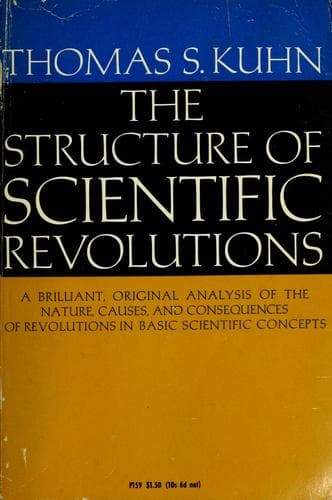
The Structure of Scientific Revolutions
by Thomas S. Kuhn, Dennis Holland
A short but demanding account of how science actually changes, arguing that progress happens through paradigms that break down rather than through steady accumulation of facts.
What It's About
Thomas Kuhn's 1962 book asks a simple question with uncomfortable answers: if science is a steady accumulation of facts, why do its fields so often lurch into new frameworks that make the old ones look mistaken? Kuhn drew on the history of physics, chemistry, and astronomy to build a model in which scientists spend most of their time inside a shared set of assumptions, solving routine problems, until anomalies pile up and a rival framework takes over.
The style is closer to an extended essay than a textbook. Kuhn writes in measured, careful prose, repeats key terms to pin them down, and revisits his own definitions. That makes parts of it slow going, but it also means you can follow his reasoning step by step. The 1969 postscript, added to the second edition, clarifies some of the vaguer language and is worth reading alongside the main text.
Reading it feels less like learning facts and more like being asked to see your own field differently. Readers who were taught science as a tidy ladder of discoveries often find the book unsettling, and that reaction is part of its point.
Read this if you…
- are curious how scientific knowledge is actually produced and why experts sometimes resist new ideas
- study science, history, or philosophy and want a foundational text that still gets argued over
- want a useful lens for understanding why established groups in any field resist change
Skip it if you…
- want a practical guide to the scientific method, experimental design, or lab work
- expect a clear, settled theory you can apply directly, since Kuhn's central term is famously loose
Key Ideas
- 1
Normal science as routine puzzle-solving
Kuhn argues that most scientific work is not bold discovery but careful problem-solving within an agreed framework. Researchers train on the same examples, share the same assumptions, and measure success by how well they fit results into what they already accept. This explains why science looks orderly and cumulative most of the time, and why its members rarely question the basics.
- 2
Anomalies and the slow buildup of crisis
Failures to fit the framework are not usually treated as refutations at first. Scientists tend to adjust their methods, blame experiments, or set anomalies aside. Kuhn describes how these unresolved problems can accumulate until the field enters a period of visible crisis, where people start doubting the foundations and trying out alternatives.
- 3
Revolutions as replacement, not gradual correction
A new paradigm does not simply add facts to the old one. It reorganizes which questions count as important and which results count as evidence. Kuhn compares the switch to a change in perception, like a figure that suddenly looks like a different image, and argues that the old and new frameworks are hard to compare directly.
- 4
Why textbooks hide the messy history
Kuhn points out that science textbooks often present past theories as steps toward today's knowledge, which makes earlier work look like a series of mistakes. He argues this makes the history of science seem more linear than it was and that the reconstructed story serves the current community more than the historical record.
Limitations
The central term 'paradigm' is notoriously slippery, and Kuhn used it in several senses, which critics have long seen as a weakness. Karl Popper and Imre Lakatos both argued that Kuhn made scientific change look more like group psychology than rational judgment. The examples come mostly from the physical sciences, so the model fits biology and the social sciences less neatly. Its popular afterlife has also outrun its argument: 'paradigm shift' is now a business cliché that Kuhn would not recognize.
Questions Readers Ask
- Is The Structure of Scientific Revolutions still worth reading?
- Yes, especially if you want to understand debates about how science works. It is one of the most cited books in the philosophy and history of science. Its ideas are contested rather than outdated, so reading it alongside critics such as Popper or Lakatos gives a fuller picture than Kuhn alone.
- How does Kuhn compare with Karl Popper?
- Popper stresses bold hypotheses and attempts to falsify them as the mark of good science. Kuhn describes what working scientists actually do, which is mostly defend a shared framework until it fails. If you want a normative account, Popper is the usual starting point; for a descriptive one, Kuhn is.
- Is Dennis Holland a co-author of this book?
- As far as I know, the 1962 book is by Kuhn alone, and I cannot confirm a Dennis Holland credit. The listing may reflect a different edition, a companion volume, or a metadata error, so check the cover and title page of the edition you are considering.
- Published
- 1955
- ISBN
- 9780226458113
- Difficulty
- intermediate
- Category
- Science
Book details and cover from Google Books.
Ready to read The Structure of Scientific Revolutions?
Get your copy on Amazon, or listen to it on Audible. We earn a commission if you buy through these links.