
We earn a commission if you buy through these links. Learn more
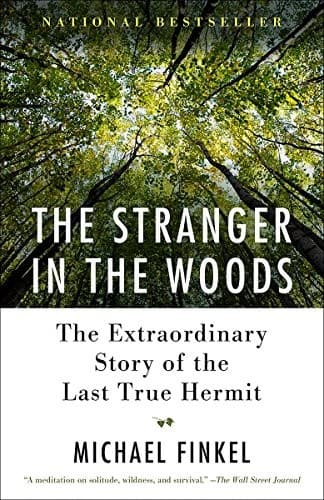
The stranger in the woods
Guide by the Books of the Day editors · Updated · How we write our guides
A quietly unsettling true story of a man who lived alone in the Maine woods for nearly three decades, worth reading for its questions about solitude, theft, and how much of a life can ever be known.
What Creators Say About The stranger in the woods
2 creators reviewed The stranger in the woods on YouTube between 2017 and 2018, with 4.5K views between them. Their opinions are their own; we picked these reviews, we didn't write them.
What It's About
The Stranger in the Woods follows Christopher Thomas Knight, who walked into the Maine woods in his early twenties and spent roughly 27 years living near a pond without any sustained contact with other people. He survived mostly by raiding the seasonal cabins and summer camps of people who were away, taking food, supplies, and other necessities. Michael Finkel, a journalist, reconstructs the story from conversations with Knight after his arrest, from interviews with the people whose property was taken, and from the investigation that led to his capture.
The book reads like a mystery at first, with a man who vanished and a string of break-ins that puzzled local police. Finkel's prose is brisk and plain, and he avoids romanticizing his subject. Much of the book's tension comes from the gap between what Knight did and what he says he felt, because Knight is reticent and Finkel is candid about how little he can reach inside that solitude.
Reading it is an uneasy but absorbing experience. The first half moves quickly and feels closer to crime reporting than to philosophy. Later sections slow down to consider what silence and isolation do to a person, and some readers will find those passages thinner than the more vivid account of survival that comes before them.
Read this if you…
- are curious about people who step outside ordinary society and what that does to them
- enjoy narrative nonfiction that reads like a true-crime investigation with a philosophical undercurrent
- want a short, direct book that raises big questions about solitude without lecturing
Skip it if you…
- want a deep dive into the psychology of isolation or a detailed inner portrait of the hermit
- are uneasy reading about a real person's thefts and want the story to feel more clearly redemptive or condemnatory
Key Ideas
- 1
Solitude that drifted into permanence
Knight did not leave society for a grand reason or a spiritual vow. He walked away in a moment of restlessness and then stayed, and the book's central puzzle is how a short impulse became a lifetime. Finkel treats this drift as more revealing than any stated philosophy, since it shows how easily a life can continue by default.
- 2
Survival through theft
Knight's existence depended on taking from the cabins and camps around him, and he was careful enough to avoid detection for years. The book takes the ethics of this seriously, asking what it means to live off other people's property while keeping yourself hidden. It is an uncomfortable part of the story and not treated as a charming quirk.
- 3
Silence as something lived, not preached
Unlike Thoreau or other famous retreats from society, Knight did not write, teach, or build a system of thought around his isolation. The book asks whether silence alone can give a life meaning, or whether the value people attach to hermits says more about readers than about the hermit. Finkel leaves that question open.
- 4
The limits of knowing a silent subject
Because Knight rarely explains his inner life, the book is partly about the difficulty of biography when a subject withholds. Finkel is open about what he could confirm and what he had to infer. That honesty makes the book more trustworthy, though it also means the central character often remains at a distance.
Limitations
Much of the account rests on Knight's own recollections, which are partial and sometimes self-serving, and on Finkel's reconstruction of events he did not witness. Knight's inner life stays largely opaque, so readers looking for a full psychological portrait may feel the book stops short. The later reflections on solitude are less developed than the narrative of survival. Finkel was dismissed from The New York Times Magazine in 2002 after it emerged he had fabricated parts of a story, and some readers weigh that history when judging his reporting.
Questions Readers Ask
- Is The Stranger in the Woods a true story?
- Yes. It is nonfiction based on the life of Christopher Thomas Knight, who lived alone in Maine's woods for about 27 years before being arrested in 2013. Finkel reconstructed the account from interviews, investigative records, and conversations with Knight, so it is a reported work rather than a memoir written by the subject.
- How does it compare to Walden?
- Walden is Thoreau's deliberate, philosophical account of choosing simplicity and writing about it. The Stranger in the Woods covers a man who never framed his solitude as a philosophy. If you enjoy Walden's reflections, this book offers a sharper, more ambiguous counterpoint about what isolation looks like when it is not an argument.
- Who is this book best suited for?
- It suits readers who like true stories with a strong central character and do not need a neat moral. It is a good fit for people interested in solitude, unusual lives, or the ethics of survival. Readers who want a heavily analytical or research-driven book on isolation may want something more academic.
- Published
- 2017
- ISBN
- 9781101924907
- Difficulty
- beginner
- Category
- Biographies
Book details and cover from Google Books.
Ready to read The stranger in the woods?
Get your copy on Amazon, or listen to it on Audible. We earn a commission if you buy through these links.