
We earn a commission if you buy through these links. Learn more
The Stone Diaries
A quietly inventive Pulitzer-winning novel that turns one ordinary woman's century into a meditation on memory, self and the stories we tell about our lives.
What It's About
The Stone Diaries follows Daisy Goodwill Flett from her birth in Manitoba in 1905 to old age. From the outside her life looks almost unremarkable: marriages, children, housework, a garden, and long stretches of ordinary days. Shields gives that life its weight by refusing a single voice. Daisy's story is told by a shifting set of narrators, and the book borrows the forms of everyday documents, such as obituaries, letters and lists, to show how a person gets reduced to a few paragraphs by everyone who writes about her.
The prose is calm, witty and precise, and the book moves through time in loose, unhurried sections rather than a tight plot. Early on you notice that Daisy is often most present in what other people say about her, or in what they leave out. The result is less a page-turner than a layered portrait that asks you to slow down and attend to small domestic moments, and to notice how much those moments carry.
Reading it feels a bit like paging through a family album: tender in places, unsettling in others, and often funny. It rewards patience and rereading, and many readers finish it with the sense of having lived inside a life rather than watched one from a distance.
Read this if you…
- want a novel about an unremarkable life that becomes quietly profound
- enjoy experimental form that still reads smoothly and rewards close attention
- are interested in twentieth-century Canadian history or the everyday lives of women
Skip it if you…
- want a fast plot with suspense or a clear sense of forward momentum
- find shifting narrators and fragmented structure frustrating when you want one steady voice
Key Ideas
- 1
A life told through many voices
Shields does not give Daisy one steady narrator. Different voices describe her at different ages, and some of them are wrong, partial or overconfident. The reader has to assemble a picture from contradictory fragments, which makes the act of biography itself a subject of the novel.
- 2
Ordinary life as the real subject
The book takes seriously the things most novels skip: cooking, gardening, raising children, grief and small disappointments. It argues that these are not background to a life but the substance of it, and it finds drama in routine without inflating it into melodrama.
- 3
Memory, gaps and what records leave out
Official records, family accounts and personal memory all disagree in this book. Shields uses those gaps to ask how much of a person can ever be recovered after they are gone, and how much of any life is shaped by what others choose to remember.
- 4
Women's work and quiet domestic history
Daisy's world is largely domestic, and the novel treats that world with more respect than many readers expect. It shows how a woman's influence can be real and wide-reaching even when it goes unrecorded in public life.
Limitations
Some readers find the structure too diffuse, and the deliberate restraint can feel like emotional distance until the payoff arrives. The book's focus is a single, fairly conventional life, so its social range is narrow compared with broader family sagas. Its postmodern techniques were striking when it appeared in 1993 and can feel more familiar now, though the writing itself still holds up well.
Questions Readers Ask
- Is The Stone Diaries a good first literary novel?
- It can be, as long as you are comfortable with a non-linear structure and do not need a strong plot to stay engaged. The sentences are accessible and the chapters are short, so the book is not hard to read. Readers who want a clear story from start to finish may find the shifting narration tiring at first.
- How does it compare with Alice Munro's short stories?
- Both writers are interested in ordinary lives in small towns and in how memory shapes people. Shields works at novel length and experiments more openly with form, while Munro is known for compressed, precise stories. If you enjoy Munro's attention to domestic detail, you will likely appreciate this book.
- Is it still worth reading today?
- Yes. Its questions about how a life is recorded, who gets to narrate it and how much remains unknown are still current. Its formal games may feel less surprising than they did in the early 1990s, but the emotional honesty of the portrait holds up well.
- Published
- 1993
- ISBN
- 9780007666232
- Difficulty
- intermediate
- Category
- Fiction
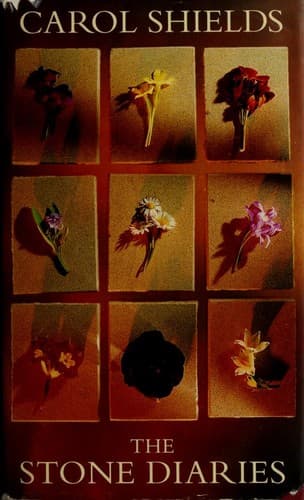
Book details and cover from Google Books.
Ready to read The Stone Diaries?
Get your copy on Amazon, or listen to it on Audible. We earn a commission if you buy through these links.