
We earn a commission if you buy through these links. Learn more
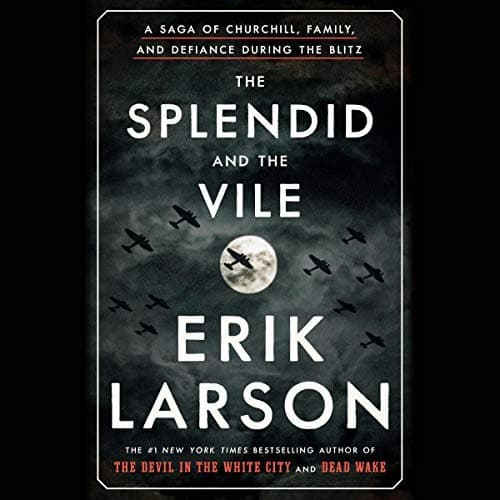
The splendid and the vile
by Erik Larson
Erik Larson's narrative history of Churchill's first year as prime minister, weaving the London Blitz with the private diaries and letters of his family and staff.
What It's About
The Splendid and the Vile covers roughly the first year of Winston Churchill's time as prime minister, from the spring of 1940 into the bombing of London that began that autumn. Larson's central move is to view this period from inside the house rather than only from the war rooms. He leans heavily on private material, including diaries and letters from members of the Churchill household, and uses those voices to show what daily life looked like for a prime minister, his family, and the staff who kept the government running while the city was under attack.
The result reads more like a novel than a policy history. Larson moves between Downing Street, the country retreat, and the streets of London, cutting from a cabinet crisis to a family meal to a neighborhood after a night raid. Short chapters and a steady focus on individual people keep the momentum up, and he explains the military and political stakes without drowning the reader in them. Expect vivid scenes and a strong sense of atmosphere, with the dread and dark humor of wartime London coming through clearly.
It is not a comprehensive account of the war, and it does not try to be. The narrative is shaped by its sources and warm toward its subjects, so readers who want a detached, analytical reckoning with Churchill's decisions will need to look elsewhere. Think of it as an intimate portrait of a leader and a city under sustained pressure, told with a storyteller's eye.
Read this if you…
- want a vivid, character-driven introduction to Britain in 1940 and 1941
- are curious about what daily wartime life felt like in London
- enjoy narrative nonfiction that reads like a novel but stays tied to sources
Skip it if you…
- want a detailed military or strategic analysis of the Battle of Britain
- are looking for a balanced history that gives equal weight to the German side and the wider war
Key Ideas
- 1
Leadership as a private, human struggle
The book shows Churchill as a man with moods, fatigue, appetites, and worries, not only as the author of famous speeches. Larson pays attention to how his health, his habits, and his household shaped the decisions made under pressure. The reader comes away with a sense of the person behind the public myth, which makes the historical stakes feel more immediate.
- 2
The Blitz seen from street level
Rather than treating the bombing as a backdrop, the book follows how Londoners adapted to nightly raids, shelters, disrupted sleep, and the effort to keep ordinary routines going. These passages give a concrete feel for endurance and fear. They also show how the war was experienced by people who had no say in its strategy.
- 3
The household as a window onto power
By focusing on the Churchill family and the staff around them, Larson turns domestic life into a way of seeing the government. Family members took on wartime roles and reacted to events in their own ways. Their letters and diaries reveal tensions and loyalties that official records tend to smooth over.
- 4
Private records as the engine of the story
Larson builds scenes from diaries and correspondence, which gives the book its texture and momentum. The method also raises questions about how much dialogue and interior detail can be trusted when reconstructed decades later. Readers who pay attention will notice how the author balances documented fact with narrative shaping.
Limitations
The book's tight focus on one year and one household is its strength, but it also narrows the view. Critics have noted that the perspective is heavily British and centered on Churchill's circle, leaving out much of the broader war, the Axis leadership, and the wider world. Because much of the drama comes from personal sources, some scenes are reconstructed in novelistic detail, and readers wanting strict documentation may find that frustrating. The warm tone can also feel uncritical about Churchill's choices.
Questions Readers Ask
- Is The Splendid and the Vile a good first book about World War II?
- It can be, especially for readers who find straight military history dry. It focuses on people and atmosphere rather than battle maps and order of battle. Once you finish, you may want a more comprehensive overview of the war to fill in the wider context the book leaves out.
- How does it compare to Larson's other narrative histories?
- It follows the same approach he uses elsewhere: a small set of characters, a dramatic setting, and a close reliance on primary sources. Readers who enjoyed his other books will likely find the style familiar. The wartime setting gives it a heavier emotional weight than some of his earlier work.
- Does it teach much about Churchill's political decisions?
- It touches on them, but mainly as they affect the people around him and the mood of the country. If you want a detailed account of the policy debates and the reasoning behind specific decisions, you will need a dedicated political biography alongside it.
- Published
- 2020
- ISBN
- 9782749157382
- Difficulty
- beginner
- Category
- Tech
Book details and cover from Google Books.
Ready to read The splendid and the vile?
Get your copy on Amazon, or listen to it on Audible. We earn a commission if you buy through these links.