
We earn a commission if you buy through these links. Learn more
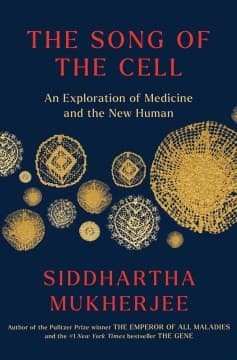
The Song of the Cell
Guide by the Books of the Day editors · Updated · How we write our guides
A sweeping, accessible history of the cell as the unit of life, linking microscopy, cancer, stem cells, and gene editing into one readable narrative.
What Creators Say About The Song of the Cell
2 creators reviewed The Song of the Cell on YouTube in 2023, with 8.5K views between them. Their opinions are their own; we picked these reviews, we didn't write them.
What It's About
The Song of the Cell is Siddhartha Mukherjee's attempt to make the cell the main character of biology. Rather than organizing the story around a disease, as his earlier bestseller on cancer did, he follows the cell as an idea and as a physical object: how it was first glimpsed under early microscopes, how it was reframed as the basic building block of living things in the nineteenth century, and how it became the lens through which modern medicine understands development, immunity, and illness.
The approach is narrative history braided with laboratory detail. Mukherjee moves between generations of researchers and recent work on stem cells, the immune system, cancer, and genetic engineering. He explains technical concepts in plain language and keeps attention on the people who made the discoveries, the arguments they had, and the wrong turns they took. The tone is warm and essayistic, with long passages that read more like storytelling than a textbook.
Reading it feels like being guided through a museum of ideas by a physician who clearly cares about the patients at the end of the chain. It rewards patience. Some sections on molecular biology are dense, and the pace slows where the science gets hard. Expect a book that builds a mental model over several hundred pages rather than one that hands you quick takeaways.
Read this if you…
- want a single, coherent story that connects microscopy, development, cancer, and gene editing
- enjoyed Mukherjee's earlier narrative histories and want more of his clear, humane style
- are curious about how scientific ideas are built over centuries, not just what the current findings are
Skip it if you…
- want a short, light read or quick practical takeaways about health
- are looking for a hands-on guide to cell biology or a textbook with diagrams and exercises
Key Ideas
- 1
The cell as the unit of life
The book traces how the idea that living things are made of cells, and that cells arise only from other cells, emerged slowly through microscopy and argument. Mukherjee shows why this single principle still organizes nearly all of biology, from embryos to tumors, and why it took so long to be accepted.
- 2
Cells are dynamic, not static
A cell is not a fixed unit. It communicates with its neighbors, changes its identity, and responds to its environment. Mukherjee uses development and stem cells to show that much of biology is about how cells decide what to become and when to stop, which makes the cell feel more like a participant in a conversation than a passive container.
- 3
Disease as a breakdown of cellular behavior
Cancer and immune disorders are framed as failures in how cells grow, cooperate, and recognize one another. This clinical perspective ties the abstract science to real illness and explains why oncology and immunology figure so heavily. It also makes the reader see disease as a question of cellular communication gone wrong.
- 4
Engineering the cell and its ethics
The later chapters look at reprogramming cells, gene editing, and cell-based therapies. Mukherjee presents both the medical promise and the uncertainties, including safety, access, and the question of how far humans should go in rewriting the basic units of life. The discussion is measured rather than alarmist.
Limitations
Critics sometimes note that the book covers a very wide range of topics, so some threads feel brief and others feel overextended. The later chapters on recent advances can read as a survey of exciting work rather than a settled account, and fast-moving fields like gene editing and cell therapy will change faster than any print book. Some readers find the early historical sections more engaging than the modern molecular material. The book also leans heavily on the author's own clinical perspective, which gives it warmth but occasionally narrows the view.
Questions Readers Ask
- Do I need a biology background to read The Song of the Cell?
- No, but it helps to be comfortable with basic ideas like DNA, proteins, and the immune system. Mukherjee explains most concepts as he goes and uses history to make them concrete. Expect the molecular sections to require slower reading, and be ready to reread a few passages before the connections click.
- How does it compare to The Emperor of All Maladies?
- The Emperor of All Maladies is organized around one disease and reads as a tightly structured narrative with a clear arc. The Song of the Cell is broader and more diffuse, following a biological idea across many fields. If you want a focused story, the earlier book is the better choice; if you want a sweeping view of how cell biology developed, this one fits.
- Published
- 2022
- ISBN
- 9781529111781
- Difficulty
- intermediate
- Category
- Science
Book details and cover from Google Books.
Ready to read The Song of the Cell?
Get your copy on Amazon, or listen to it on Audible. We earn a commission if you buy through these links.