
We earn a commission if you buy through these links. Learn more
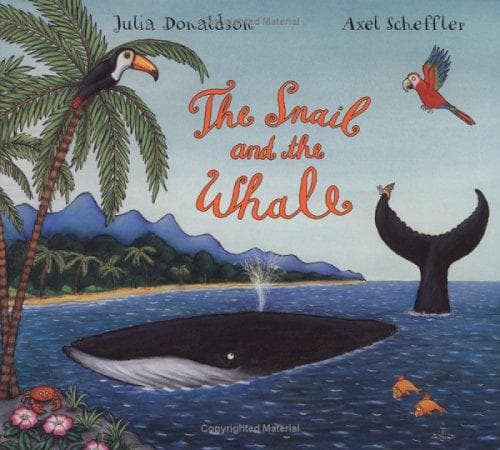
The Snail and the Whale
A rhyming picture book about a tiny snail who hitches a ride on a whale and sees the world, with a bouncy read-aloud rhythm that suits toddlers and early readers.
What It's About
The Snail and the Whale (2003) is a picture book written by Julia Donaldson and illustrated by Axel Scheffler, the same pair behind The Gruffalo. A small snail who spends his days on a rock in a tide pool meets a whale and climbs aboard for a ride. The journey carries them far beyond the shore, past a run of places and sights, and the story follows the snail as he finds himself a long way from home.
The book is written in rhyming verse with a steady beat, meant to be read aloud. Donaldson keeps the lines short and the rhymes bright, so young children pick up the sing-song pattern quickly and start joining in on repeated phrases. Scheffler's illustrations do much of the storytelling: the contrast in scale between the tiny snail and the enormous whale, and the colourful scenes of sea and shore, add detail the text leaves out.
Reading it is brief and warm rather than demanding. A typical read-through takes only a few minutes, and it works best as a shared experience between an adult and a child, with pauses to point at pictures and talk about what is happening. Adults often find the rhythm pleasant to repeat, and it is a clear example of how a simple idea, a small creature and a big journey, can carry a whole story.
Read this if you…
- want a rhyming read-aloud for a child roughly three to six years old
- are looking for a short, gentle bedtime story with lots of pictures to talk about
- enjoy the Donaldson and Scheffler partnership and want another book in the same spirit as The Gruffalo
Skip it if you…
- want a story with complex characters, a tense plot, or surprises for adult readers
- are looking for accurate natural history about snails or whales, since the book is whimsical rather than factual
Key Ideas
- 1
Size and an unlikely partnership
The pairing of a tiny snail with a huge whale drives the whole book. It finds humour and warmth in the odd friendship between two creatures who could hardly be more different, and it quietly suggests that small creatures can go places that big ones cannot. Young readers tend to enjoy the comic gap in size as much as the story itself.
- 2
Travel and seeing the wider world
The story is built around movement, moving from one setting to the next and showing a child-sized view of a large world. It gives small listeners a sense of distance and variety without any heavy explanation, and it invites them to name the places and creatures they see in the pictures.
- 3
Rhyme as the engine of the story
Donaldson uses rhyme and regular rhythm not as decoration but as the main way the story moves forward. The verse makes the book easy to memorise and fun to perform, which is why it is so often read aloud in nurseries and classrooms. The rhythm also gives adults a steady, predictable pattern to read with confidence.
- 4
Home and the pull of the familiar
Beneath the adventure is a simple emotional thread about wanting to return to a familiar place. The snail's small, ordinary home is set against the wide, strange world he visits, which gives the book a gentle lesson about valuing where you belong, pitched at a level that very young children can grasp.
Limitations
Some adults find the rhymes a little forced in places, and the episodic structure of a journey from one scene to the next can feel slight after many rereads. The plot is light and there is little real tension, so older children may find it too simple for them. The marine details are fanciful rather than scientific, which is fine for its audience but may bother a reader who wants facts. Its charm depends on the read-aloud experience, so it works less well as a silent book for a reader on their own.
Questions Readers Ask
- Is The Snail and the Whale suitable for a child learning to read?
- Yes, with support. The text is short and the rhymes help children predict words, so it suits a read-aloud for three to six year olds. Early independent readers can often manage parts of it with an adult nearby, and it is a good stepping stone toward longer picture books.
- How does it compare to The Gruffalo?
- Both share Donaldson's rhyming verse and Scheffler's illustrations. The Snail and the Whale is more of a travel story with a wider range of settings, while The Gruffalo has a tighter structure and a more polished comic build. Many families find The Gruffalo the stronger book, but this one suits children who love journeys and the sea.
- Is it still relevant or worth reading today?
- Yes. It remains a popular picture book in libraries and classrooms, and its themes of size, travel and home are timeless. It is not a book about the present day, so there is nothing to date, and it is most useful as a reliable read-aloud rather than as a source of information.
- Published
- 2001
- ISBN
- 9780330517348
- Difficulty
- beginner
- Category
- Fiction
Book details and cover from Google Books.
Ready to read The Snail and the Whale?
Get your copy on Amazon, or listen to it on Audible. We earn a commission if you buy through these links.