
We earn a commission if you buy through these links. Learn more
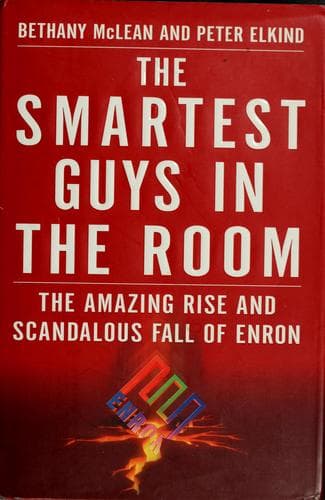
The Smartest Guys in the Room
by Bethany McLean, Peter Elkind
A rigorous, readable investigation of how Enron's accounting, trading, and internal culture hid its problems until the 2001 collapse, written by reporters who covered the story as it unfolded.
What It's About
The Smartest Guys in the Room is a narrative investigation of Enron, the Houston energy company that went from a pipeline operator to a celebrated 'new economy' giant and then to one of the largest bankruptcies in American history. Bethany McLean and Peter Elkind were Fortune reporters, and the book reads like long-form magazine journalism: scene-driven, built on interviews and documents, and organized around people and decisions rather than abstract theory.
The book's central question is how a company with so much apparent success could be so hollow underneath. The authors follow the executives, the trading floors, and the financial structures that made Enron's numbers look better than its underlying business. You get a clear sense of how the company's ambitions, its incentive systems, and its willingness to bend accounting rules fed each other, and why the people inside often believed they were the smartest in the room.
Reading it is a brisk, sometimes infuriating experience. The financial mechanics are explained in plain language, but the cast is large and the stakes are personal. It works best as a story of a corporate culture going wrong, and it leaves you with a sharper sense of how to read company financials and how easily hype can outrun reality.
Read this if you…
- want a detailed, well-sourced account of the Enron collapse rather than a summary
- are interested in how accounting, incentives, and corporate culture can combine to hide financial trouble
- enjoy investigative business journalism that reads like a thriller without inventing drama
Skip it if you…
- want a neutral, academic analysis of corporate governance or financial regulation
- find long casts of executives and dense financial detail hard to follow
Key Ideas
- 1
Accounting that outran the underlying business
The book shows how Enron used aggressive accounting choices, including ways of booking expected future profits early, to present earnings that its actual cash generation did not support. The mismatch between reported results and real economics is the thread that connects most of the story.
- 2
Off-balance-sheet partnerships and hidden debt
Enron set up partnerships and special entities that kept large amounts of risk and debt away from its main financial statements. The authors explain these structures clearly enough that a general reader can see why they were attractive to insiders and why they were so hard for outsiders to evaluate.
- 3
A culture built on competition and reward
Performance ranking systems, lavish bonuses, and a relentless focus on deal volume encouraged people to chase short-term wins and avoid bad news. The book argues that the incentives inside the company mattered as much as any single fraud, because they made concealment the path of least resistance.
- 4
Trading as a business built on image
Enron's trading operations and its online platforms were sold to investors as proof of a radically new business model. The book examines how much of that image rested on confident projections and market perception, and how little of it survived close scrutiny once the company's cash problems surfaced.
- 5
Warning signs that were missed or dismissed
Throughout the book, analysts, employees, and some insiders raise concerns that are brushed aside. Tracing those moments gives the story its tension and offers a practical lesson about how skeptical questions get handled inside powerful organizations.
Limitations
The book is built on reporting from 2001 to 2003, so it does not cover the full course of later prosecutions, appeals, and subsequent research into Enron and the broader accounting profession. Its focus is on the company and its leaders, which means the wider failures of auditors, banks, and regulators get less space than some readers may want. Critics also note that its narrative sympathies are clearly with the investigators and employees, so it is a strongly shaped account rather than a detached one. The large number of players can make the middle sections feel crowded.
Questions Readers Ask
- Do I need a finance background to understand it?
- No. The authors explain the key accounting and trading ideas in plain language and focus on people and decisions. Some sections on partnerships and energy trading require concentration, but a general adult reader with curiosity about business should be able to follow the story without prior training.
- Is the book still relevant after the Enron collapse?
- Yes. Its core lessons about incentives, opaque financial structures, and the danger of trusting a company's own narrative still apply to modern corporate scandals. Readers who want the latest legal outcomes will need to supplement it with newer sources.
- How does it compare with the Enron documentary?
- The 2005 documentary draws heavily on the same reporting, so the two work well together. The book offers more detail on the financial mechanics and the internal dynamics, while the film is more compact and visual.
- Published
- 2003
- ISBN
- 9780670913718
- Difficulty
- intermediate
- Category
- Business
Book details and cover from Google Books.
Ready to read The Smartest Guys in the Room?
Get your copy on Amazon, or listen to it on Audible. We earn a commission if you buy through these links.