
We earn a commission if you buy through these links. Learn more
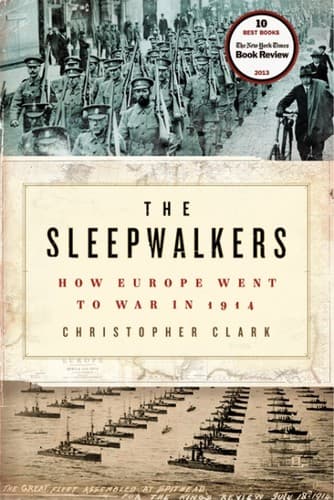
The Sleepwalkers
A dense, expert reconstruction of the diplomatic crises that led Europe into 1914, valuable for showing how many capitals shared the blame.
What It's About
The Sleepwalkers is a long, detailed account of how the great powers of Europe slid into the First World War in the summer of 1914. Clark starts earlier than most readers expect, with the Balkan crises of 1912 and 1913, and follows the decisions made in Vienna, Belgrade, St Petersburg, Berlin, Paris and London. Rather than hunting for a single villain, he reconstructs a tangle of ultimatums, misread signals, domestic pressures and half-formed plans, showing how each capital acted on assumptions that turned out to be wrong.
His style is that of a patient narrator who moves between capitals and between levels of government, from ministers and ambassadors to monarchs and military staffs. The chapters are dense with cables, memoranda and private diaries, and the cast is large, so readers need to keep track of who is talking to whom and why. The experience is less like a thriller than like watching a complicated board game where you already know the result but not how the players reached it. Clark writes with precision and occasional dry wit, and he rewards slow reading.
It is not a battle history or a social history of the war's experience. If you want the trenches or the lives of ordinary soldiers, look elsewhere. This book stops at the point where the decisions were made.
Read this if you…
- want the most detailed modern account of the July Crisis
- are curious how a war was built out of diplomacy and not a single blunder
- already know the basics of 1914 and want a deeper, more contested reading
Skip it if you…
- want a narrative of trench warfare or the experience of soldiers and civilians
- find long stretches of diplomatic detail tiring or want a short introduction
Key Ideas
- 1
War as the product of many decisions
Clark argues that 1914 was not the outcome of one government's master plan. Each major power made choices under pressure, with incomplete information, and those choices interacted to produce a war that no capital had fully chosen. The book's value lies in tracing these interactions step by step rather than assigning a single cause.
- 2
What the sleepwalking metaphor means
The title describes leaders who acted with confidence while failing to see where their steps were leading. Clark uses the image to describe a political culture in which mobilization plans, questions of prestige and fear of humiliation pushed states forward. It is a provocative label rather than a verdict of innocence, and readers should judge for themselves how far it explains the choices made.
- 3
The Balkans as the engine of crisis
Clark gives heavy weight to the Balkan dynamics: Serbian nationalism, Austro-Hungarian anxieties, Russian ambitions in the region, and the wars of 1912 and 1913 that reshaped the balance of power. Seen this way, the July crisis looks less like a sudden break and more like the culmination of years of local conflict with wider consequences.
- 4
Challenging the German war guilt thesis
The book pushes back against the older view, associated with Fritz Fischer, that Germany bore the main responsibility for the war. Clark spreads blame across several capitals and asks readers to weigh each government's choices. This is the book's most argued and most contested point, and it shapes how the rest of the narrative is read.
Limitations
Critics have argued that the sleepwalking framing softens responsibility, especially German responsibility, and that the book can read as too generous to decision-makers who had clear alternatives. Others note that its focus on elite politics leaves out public opinion, economic pressures and the momentum of military planning. Some historians find the Serbian and Russian chapters more persuasive than the German ones. The book is also very long and can be hard to follow without notes or a timeline open alongside.
Questions Readers Ask
- Is The Sleepwalkers a good first book on World War I?
- Probably not as a first book. It assumes you can keep track of many ministers, alliances and crises at once. A shorter general overview will give you the broad outline, after which this book adds depth on the diplomacy of 1914. Readers who already know the basic chronology will find it rewarding.
- How does it compare with Margaret MacMillan's The War That Ended Peace?
- Both cover the road to 1914 and both move beyond simple blame. MacMillan writes more broadly and with a narrative ease that many readers find easier going. Clark goes deeper into the detail of the July Crisis and makes a sharper argument about the shared responsibility of the great powers.
- Is the book still relevant?
- Yes. It remains a central reference in debates about how wars begin and is widely taught. Its arguments about responsibility are still contested, so reading it alongside critics of the sleepwalking thesis is worthwhile.
- Published
- 2013
- ISBN
- 9780062199225
- Difficulty
- advanced
- Category
- History
Book details and cover from Google Books.
Ready to read The Sleepwalkers?
Get your copy on Amazon, or listen to it on Audible. We earn a commission if you buy through these links.