
We earn a commission if you buy through these links. Learn more
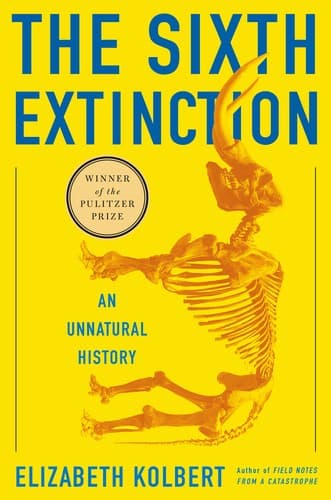
The Sixth Extinction
by Elizabeth Kolbert, Marcel Blanc
Guide by the Books of the Day editors · Updated · How we write our guides
A clear, reported look at Earth's mass extinctions and the evidence that human activity is driving a sixth, written with field scenes that make the science concrete.
What It's About
Elizabeth Kolbert's book starts from a sobering claim: Earth has already gone through five mass extinctions, and the evidence suggests we may be causing a sixth. She builds the argument from reporting trips and interviews rather than a single lab study, pairing scientific history with scenes from the field. Much of the book looks back at how researchers came to recognize that life has been wiped out in waves, from early naturalists puzzling over fossils to modern scientists reading rock layers and ice records.
The present-day sections are where the book comes alive. Kolbert visits places where amphibians are dying from a spreading fungus, follows researchers tracking coral reefs under pressure from warming and acidifying seas, and talks with people trying to save species that may already be too few to recover. The tone is calm and reportorial rather than alarmist. She lets scientists and skeptics speak for themselves, which gives the argument weight without turning it into a lecture.
The reading experience is steady and conversational, closer to long magazine feature writing than to a textbook. Each section is short enough to finish in one sitting, and the connecting thread is a question rather than a plot: what does it mean that a single species, ours, could reshape the planet's living systems this quickly? Expect a mix of history, field notes, and grim arithmetic delivered without much decoration.
Read this if you…
- want a clear overview of the science of extinction without needing a biology background
- enjoy narrative nonfiction that mixes reporting trips with scientific history
- are curious how human activity is changing ecosystems and want the evidence laid out carefully
Skip it if you…
- want practical steps for protecting wildlife or a hopeful plan for the future
- prefer dense technical detail or a deep dive into one species, method, or region
Key Ideas
- 1
Mass extinctions are a recurring part of history
Earth has experienced several episodes in which a large share of its species disappeared within a relatively short span of geological time. Kolbert explains how scientists reconstruct these events from fossils and rock layers, and why recovery afterward took millions of years. This background gives the claim about a sixth extinction its scale and context.
- 2
How science learned to accept extinction
For a long time, many thinkers resisted the idea that whole species could vanish, since it seemed to conflict with a harmonious natural order. The book traces how that resistance gave way to evidence from paleontology and geology. Seeing this shift helps readers understand that the current scientific picture was hard won.
- 3
Human pressure as the main driver today
Kolbert argues that habitat destruction, invasive species, pollution, and climate change are pushing extinction rates well beyond what the fossil record would suggest is normal. She presents these drivers as interconnected rather than as isolated problems. The case rests on accumulated observations, not a single dramatic number.
- 4
Amphibians and reefs as warning cases
Concrete examples carry much of the argument. Declining frog populations and stressed coral reefs show how changes in one part of an ecosystem can ripple outward unpredictably. These cases make abstract talk of biodiversity loss feel specific and observable.
- 5
Extinction as a moral and emotional question
Beyond the science, the book asks what it means for a species to disappear forever and what responsibility comes with that knowledge. Kolbert leaves room for readers to weigh those questions themselves. The reflective passages give the reporting a human center.
Limitations
The book is now more than a decade old, so its specific figures and the status of particular species have moved on, and readers should check current data. Some critics find the travelogue sections uneven, and the emphasis falls more on diagnosis than on solutions. Kolbert covers a lot of ground quickly, so anyone wanting depth on a single topic will need further reading. The core framing of an ongoing sixth extinction is widely discussed among scientists, but its details and timing remain debated.
Questions Readers Ask
- Is The Sixth Extinction still worth reading?
- Yes, as a clear introduction to the idea and the evidence behind it. The specific numbers and species updates reflect the mid-2010s, so pair it with newer reporting or a current extinction database if you need up-to-date figures. Its main strength is the framing, which has held up well.
- How does it compare to more technical books on extinction?
- It is more journalistic and less technical than a scientific textbook or a specialist monograph. It is also shorter in scope than broad environmental histories. Readers who enjoy it often move on to more focused accounts of climate, oceans, or conservation biology.
- Published
- 2014
- ISBN
- 9782311100617
- Difficulty
- beginner
- Category
- Science
Book details and cover from Google Books.
Ready to read The Sixth Extinction?
Get your copy on Amazon, or listen to it on Audible. We earn a commission if you buy through these links.