
We earn a commission if you buy through these links. Learn more
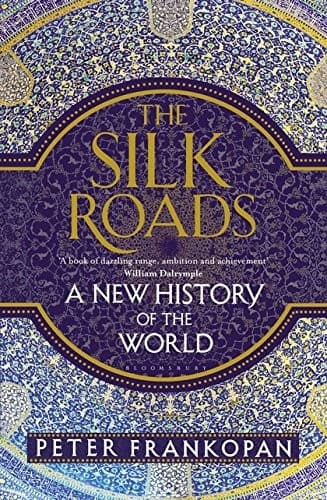
The Silk Roads
Guide by the Books of the Day editors · Updated · How we write our guides
Frankopan retells world history from the middle outward, showing how trade routes across Eurasia shaped empires, religions and ideas, and why that story still matters.
What Creators Say About The Silk Roads
2 creators reviewed The Silk Roads on YouTube between 2019 and 2023, with 2.5K views between them. Their opinions are their own; we picked these reviews, we didn't write them.
What It's About
The Silk Roads is a long, ambitious history of the world told from Central Asia and the lands between China and the Mediterranean rather than from Western Europe. Frankopan's central move is to treat the routes linking East and West as the main channel for goods, armies, faiths and diseases across roughly two and a half millennia, instead of as a side story to Greek, Roman and later European achievements.
The approach is broadly chronological and wide-ranging. The narrative moves between empires such as Persia, the Byzantine world, the early Islamic caliphates and the Mongols, with detours into commodities, epidemics and religious movements. Frankopan writes in a confident, vivid narrative style and keeps returning to one question: how did regions connected by trade influence one another? The result feels more like a sweeping tour than a dense specialist monograph.
Reading it is an experience of rapid rescaling. Familiar events are placed in a different geography, and the later chapters turn toward the present, linking old networks to modern politics and infrastructure. Readers come away with a changed sense of where history happens, though they will need to check specific claims and dates against more focused sources.
Read this if you…
- are curious about world history beyond Europe and America
- want a big-picture narrative that connects distant regions and periods
- enjoy a fast-moving, opinionated style over a cautious academic one
Skip it if you…
- want a detailed, source-by-source scholarly account
- prefer a focused study of one empire, dynasty or period
Key Ideas
- 1
History seen from the middle, not the edges
Frankopan argues that Central Asia and the Middle East were hubs of wealth, learning and power rather than peripheries waiting for Europe to act. This reorientation is the book's main contribution, and it changes how familiar episodes look once the geography is shifted.
- 2
Trade as the engine of connection
Silk, spices, metals and money are the threads that tie the story together. Merchants and caravans are presented as the people who actually built links between distant societies, often far ahead of formal states or diplomacy.
- 3
Religions and ideas travelling with commerce
Buddhism, Christianity and Islam spread in part along the same routes that carried goods. Frankopan treats these movements as exchanges of ideas and practices, not only as clashes, which gives the religious history a more connected and less confrontational shape.
- 4
Disease and empire moving along the same paths
The routes that enriched cities also carried plague and conquest. The book shows that connectivity brought costs as well as benefits, and that epidemics and invasions were as much a part of the network as silk or ideas.
- 5
Why the past still shapes the present
The closing argument ties these long networks to contemporary Eurasian politics, energy and infrastructure. This part is the most openly argued and the most contested, so readers should treat it as the author's interpretation rather than settled consensus.
Limitations
Critics have argued that the book pushes its central thesis hard, sometimes overstating how much Central Asia drove events that were shaped by many other forces. Its breadth means many episodes are covered quickly, with limited space for debate among historians. The label Silk Roads is itself a later term, and some readers find the framing loose. The concluding sections on current affairs reflect a particular viewpoint and have aged quickly as political situations have changed. Specialists may find the notes thinner than they would like.
Questions Readers Ask
- Is The Silk Roads a good first world history book?
- It can be, because the writing is readable and the scope is enormous. But that breadth means many topics are skimmed. Readers who finish it and want depth should pick up a focused book on one empire or century to balance the broad picture.
- How does it compare with a traditional world history?
- Traditional surveys usually begin with Greece and Rome and move westward over time. Frankopan starts from the east and the centre, so familiar sequences feel reordered, and the book asks readers to rethink which regions were the drivers of change.
- Is the book still relevant today?
- Its historical arguments are debated, but its focus on how Eurasian regions connect through trade, faith and conflict remains a useful lens for understanding current events. Readers should check its closing claims against recent reporting and analysis.
- Published
- 2015
- ISBN
- 9781408889930
- Difficulty
- intermediate
- Category
- History
Book details and cover from Google Books.
Ready to read The Silk Roads?
Get your copy on Amazon, or listen to it on Audible. We earn a commission if you buy through these links.