
We earn a commission if you buy through these links. Learn more
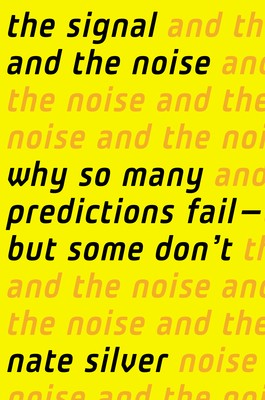
The Signal and the Noise
by Nate Silver
Nate Silver's accessible tour of why forecasts in politics, finance, weather and sports so often fail, and what the better forecasters do differently, is worth your time even if you skip the statistics.
What It's About
The Signal and the Noise, published in 2012, is Nate Silver's attempt to explain why predictions go wrong in fields from finance, weather and earthquakes to baseball, poker and elections, and what separates forecasters who do well from those who don't. It is shelved under history, but it is really a book about probability and judgment. Silver uses history as a set of case studies, moving from one field to the next and using each to illustrate a point about how predictions succeed or collapse.
His central tool is Bayesian reasoning: treating a forecast as a starting belief that should be revised as new evidence arrives, in proportion to how strong that evidence is. He argues that people who consider themselves experts often overstate what they know, and that more data does not automatically help when a model ends up fitting random noise. The tone is conversational and curious rather than mocking. He is more interested in what good forecasters do than in ridiculing bad ones.
Reading it feels like a long, friendly tour through the thinking behind recent headlines, mixing reporting, interviews and worked examples. The mathematics stays light, so you don't need a statistics background, though some passages on probability reward slow reading. It works best as a survey and a mindset guide rather than a technical manual.
Read this if you…
- want a non-technical introduction to probability and forecasting
- follow sports, politics or financial news and want to judge predictions more critically
- are curious why smart experts so often get important things wrong
Skip it if you…
- want a rigorous statistics textbook or an in-depth history of any single field
- prefer a book that stays on one subject, since this one jumps across many topics
Key Ideas
- 1
Overconfidence is the usual cause of failure
Silver's recurring argument is that forecasting errors often come less from missing information than from forecasters who are too sure of their models. Experts who express tight certainty in uncertain situations tend to be badly wrong when the unexpected happens, and the book uses financial crises and disasters to show how often this pattern repeats.
- 2
Bayesian updating as a way of thinking
Silver presents Bayes' theorem less as a formula than as a habit: start with a reasonable prior belief, then adjust it as evidence comes in, without swinging wildly on each new data point. He frames this as a practical discipline that anyone can use to judge claims, from political polls to medical news.
- 3
Separating signal from noise in data
The book's title idea is that data always mixes meaningful patterns with random variation. Silver explains how models can mistake noise for signal, especially when researchers search through many variables, and why more data is not a cure on its own if the underlying question is poorly framed.
- 4
Good forecasting depends on feedback and humility
Silver points to fields where forecasts have improved, such as weather, as examples of what works: quick feedback on accuracy, careful measurement of error, and a willingness to state probabilities rather than certainties. He suggests these habits could help experts in other fields make better predictions.
Limitations
Critics have said the chapters vary in depth and that some sections, especially on sports and poker, feel more like anecdotes than analysis. The book leans heavily on Silver's own election forecasting successes, which some readers see as self-promotion. Its Bayesian framing is sometimes presented more as a universal solution than a tool with real limits. Written in 2012, it predates the rapid growth of machine learning and later debates over forecasting accuracy, so its examples now feel somewhat dated.
Questions Readers Ask
- Is The Signal and the Noise really a history book?
- Not in the usual sense. Although it is categorized as history, its main subject is prediction, statistics and decision-making. History appears as a series of case studies, such as financial crises, earthquakes and elections, used to show how forecasts succeed or fail. If you expect a chronological narrative, you will be looking for the wrong thing.
- Is the book still relevant after 2012?
- Yes, mainly for its core ideas about overconfidence, updating beliefs and evaluating forecasts, which age well. Some specific examples and predictions are dated, and the field of machine learning has changed a lot since then. Treat it as a foundation for critical thinking rather than a current guide to the latest techniques.
- Published
- 2012
- ISBN
- 9780606368056
- Difficulty
- intermediate
- Category
- History
Book details and cover from Google Books.
Ready to read The Signal and the Noise?
Get your copy on Amazon, or listen to it on Audible. We earn a commission if you buy through these links.