
We earn a commission if you buy through these links. Learn more
The shadow children
A middle-grade dystopia told from inside a hidden attic, where a boy living in secret under a two-child law makes the cost of one rule feel personal and urgent.
What It's About
The Shadow Children is a middle-grade dystopian novel set in a future where the government limits each family to two children. Those who exceed the limit are called shadow children: they hide indoors, rarely go outside, and live with the constant fear of being discovered by the Population Police. The narrator, Luke, is a third child who has spent most of his life confined to the attic of his family's home.
The book is written in a plain, fast-moving voice, and most of its tension comes from small, claustrophobic details: a shade drawn at the wrong moment, a sound from the street, the effort of keeping a secret from a family that is itself frightened. Haddix keeps chapters short and momentum high, so the book reads quickly even when the subject is heavy. Expect a suspenseful, emotionally direct read rather than a slow worldbuilding exercise; the world is sketched through what Luke can see and hear from his hiding place.
Because it is the first book in a long series, it works as an opening rather than a complete arc. Readers who finish it will likely want to continue, and the question the book raises about who gets to decide who counts as a person is one it returns to repeatedly. It is best approached as a gripping introduction to a familiar kind of dystopia, written for younger readers but not condescending to them.
Read this if you…
- like dystopian stories that focus on ordinary families rather than revolutions
- want a fast, suspenseful novel suited to middle-grade and younger teen readers
- are interested in how population laws can turn people into secrets
Skip it if you…
- want a richly detailed political system explained at length
- need a complete, self-contained story in a single book
Key Ideas
- 1
A family under pressure
The most affecting material is the household itself. Luke's parents must balance love for a hidden child against fear of the consequences, and his siblings have to live with a secret that could cost them everything. Haddix makes the cost of the law visible in ordinary domestic choices, such as how a family explains an absence or keeps a routine intact. The emotional stakes come from people protecting each other rather than from large battles.
- 2
Rules that decide who counts as a person
The Two-Child Law is presented as a sensible policy, which is part of what makes it unsettling. The book asks readers to consider how a government can justify erasing people by labeling them illegal rather than dangerous. It is less interested in explaining political machinery than in showing how ordinary people accept the premise, and how quickly a rule can make a child feel like a problem to be solved.
- 3
Fear and secrecy as daily life
Much of the tension comes from the discipline of staying unseen: keeping quiet, controlling light, and listening for footsteps. This makes the reading experience intimate and tense, since the reader shares Luke's limited view. The approach suits readers who enjoy suspense built from restriction rather than action set pieces, and it gives the story a steady, pressing quality from the first chapters.
- 4
A gateway to a larger series
The book establishes a premise that expands across later volumes, with the stakes widening beyond one household. Its value as a standalone is limited, because it opens questions more than it closes them. Readers who enjoy the idea of a hidden world slowly coming into view will find the setup satisfying, while those who want a self-contained story may feel left hanging.
Limitations
Adult readers may find the world thinly drawn, since the focus stays tight on Luke's home and the wider government and society remain largely offstage. The prose is clear and direct, which suits its audience but can feel plain to readers used to layered narration. Because it is the opening volume, it ends with questions unresolved, and some readers find the series' expanding scope less compelling than its premise. The book also reflects the concerns of its time about population control, which some readers may find more pointed than the story needs.
Questions Readers Ask
- Is The Shadow Children suitable for adults?
- Yes, though it is written for middle-grade readers, roughly ages 9 to 13. Adults who enjoy fast, straightforward dystopias will likely finish it in a sitting or two. Readers seeking dense worldbuilding or ambiguous moral argument may find it light, but its emotional core, a child hidden away from the world, works at any age.
- Do I need to read the rest of the series?
- Not necessarily for the first book's own story, which reaches a meaningful point on its own, but it is clearly the start of a longer sequence. If you enjoy it, the sequels expand the world considerably. If you want one self-contained book, plan on being left with open questions.
- Published
- 2009
- ISBN
- 9781416990277
- Difficulty
- beginner
- Category
- Science Fiction
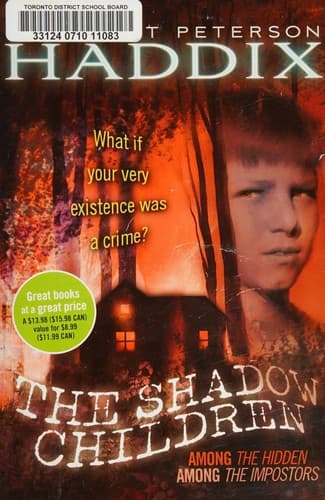
Book details and cover from Google Books.
Ready to read The shadow children?
Get your copy on Amazon, or listen to it on Audible. We earn a commission if you buy through these links.