
We earn a commission if you buy through these links. Learn more
The self illusion
Bruce Hood makes a persuasive case that the feeling of a fixed, inner self is something the brain constructs, and that other people help build it, which makes this a thought-provoking introduction to the science of identity.
What It's About
Hood's central claim is that the sense of a stable, inner "I" running our lives is something the brain builds rather than discovers. Drawing on developmental psychology, neuroscience, and social psychology, he argues that identity is assembled largely from how other people respond to us, from memories that are rebuilt each time we recall them, and from the brain's habit of explaining its own behaviour after the fact.
The style is accessible and lightly academic, with plenty of experiments and everyday examples. Hood writes as a working scientist who is comfortable with uncertainty and often presents competing views rather than settling every debate. The argument moves from how children come to recognise themselves to how adults present and defend a self to others, so the book reads as one connected story rather than a collection of separate essays.
Reading it feels less like being handed a new fact than like having a familiar assumption gently taken apart. Some readers will find that unsettling, especially if they associate the self with free will or moral responsibility. It is short enough to finish in an evening, though the ideas reward slower reading and a willingness to test them against your own experience.
Read this if you…
- are curious about how the brain produces the feeling of being a single, continuous person
- enjoy popular science that leans on experiments and examples rather than pure theory
- want a fresh angle on identity, memory, and self-deception without heavy jargon
Skip it if you…
- need a practical self-help guide to confidence, habits, or personal change
- find challenges to free will or personal responsibility hard to sit with
Key Ideas
- 1
The self as a constructed story
Hood argues that the self is less a hidden essence than a narrative the brain keeps assembling. We experience ourselves as continuous and consistent, but that continuity is largely an impression the mind produces to make sense of scattered thoughts, actions, and memories.
- 2
Other people shape who we think we are
A large part of identity, in Hood's account, comes from social feedback. Children learn to see themselves through the eyes of others, and adults keep adjusting their sense of self according to reputation, belonging, and the roles they are expected to play.
- 3
Memory is rebuilt, not replayed
Hood shows how recollection is reconstructive and open to distortion. Because our autobiography depends on memories that shift over time, the personal history we rely on to define ourselves is less fixed than it feels from the inside.
- 4
Explaining ourselves after the fact
The book highlights how the mind often supplies reasons for choices made by processes we cannot access. This post-hoc explanation makes us seem like consistent agents with clear motives, even when the real causes were quite different.
Limitations
Some readers find the book more suggestive than conclusive, since Hood often presents provocative interpretations of research that is still debated. Its scope is focused on the psychology of the self rather than philosophy, so questions about consciousness or moral responsibility get only partial treatment. Because it is a relatively short popular book, the coverage of cultural and historical variation in ideas of selfhood is thin. Readers wanting a comprehensive academic survey will need to look further.
Questions Readers Ask
- Is The Self Illusion too technical for a general reader?
- No. Hood is writing for curious non-specialists, explains the main terms as he goes, and relies on memorable experiments and everyday examples. Some passages on neuroscience are denser, but you can follow the overall argument without any background in psychology.
- Does the book say we have no real self at all?
- Not quite. Hood's point is that the self we experience as a unified inner core is a construction, not that there is no person there. He is more interested in how that sense of self is formed and why it feels so solid than in declaring it nonexistent.
- Published
- 2011
- ISBN
- 9780199897599
- Difficulty
- beginner
- Category
- Psychology
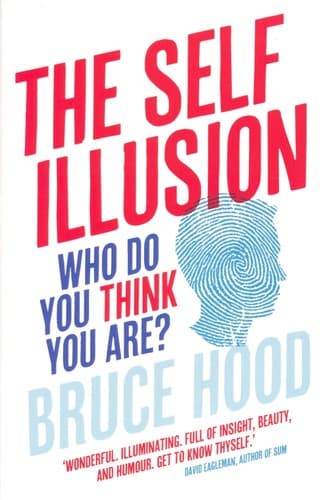
Book details and cover from Google Books.
Ready to read The self illusion?
Get your copy on Amazon, or listen to it on Audible. We earn a commission if you buy through these links.