
We earn a commission if you buy through these links. Learn more
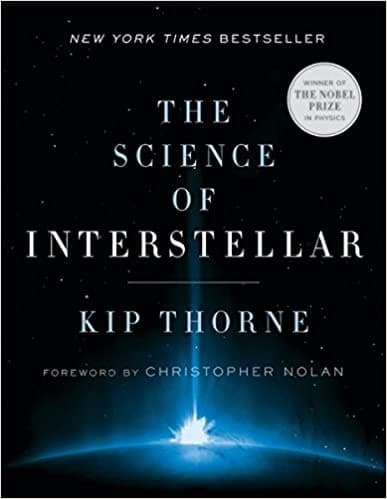
The Science of Interstellar
Guide by the Books of the Day editors · Updated · How we write our guides
Kip Thorne, the film's scientific consultant, explains the physics behind Interstellar's black holes, time dilation, and wormholes, separating established science from educated guesswork.
What Creators Say About The Science of Interstellar
2 creators reviewed The Science of Interstellar on YouTube between 2015 and 2016, with 7.9K views between them. Their opinions are their own; we picked these reviews, we didn't write them.
What It's About
The Science of Interstellar is Kip Thorne's account of the physics behind Christopher Nolan's 2014 film, which he advised on as scientific consultant. Rather than retelling the movie, Thorne uses its story as a hook to explain general relativity, black holes, wormholes, and time dilation, and to show how the film's image of a spinning black hole was built from equations.
The writing is clear and conversational, with the mathematics kept light and most ideas carried in prose and side discussions. Thorne is candid about what is well established and what is speculative, and he keeps those two categories apart. Readers also get a sense of how scientists and filmmakers worked through details, including where the story required the science to bend.
The experience is closer to sitting in on a seminar than reading a textbook. It rewards anyone who has seen the film and wants to know whether its wormhole and planetary time dilation hold up. It does not demand a physics background, though it helps to be comfortable with the idea that clocks can run at different rates depending on gravity and speed.
Read this if you…
- you enjoyed Interstellar and want to know which parts of it are real physics
- you want an accessible, friendly introduction to black holes and relativity
- you are curious how scientists and filmmakers collaborate on accuracy
Skip it if you…
- you have not seen the film and want a standalone guide to relativity, since the book leans heavily on its plot
- you want rigorous derivations or a full textbook treatment of general relativity
Key Ideas
- 1
How a black hole looks versus how it is
Thorne explains why the film's black hole, Gargantua, appears as it does. Light bent by intense gravity, along with rapid spin, produces the glowing disk and distorted shape. The book shows that the picture is a real calculation, not an artist's invention, and it explains what the image reveals about the object's structure.
- 2
Gravity slows time
The planet near the black hole, where an hour passes for every seven years elsewhere, is the film's most memorable device. Thorne walks through gravitational time dilation step by step, showing how strong gravity and fast motion both stretch time. The explanation is one of the clearest parts of the book for readers new to relativity.
- 3
Wormholes as a speculative shortcut
Thorne discusses what a traversable wormhole would require, including exotic matter with unusual properties that may not exist. He is careful to separate what the equations allow from what has been observed. This section is useful for seeing how physicists reason about possibilities they cannot yet test.
- 4
Where science and storytelling collide
The book gives a behind-the-scenes view of consulting on a major film. Thorne describes the back-and-forth with the filmmakers and where dramatic needs won out over accuracy. Readers learn how scientific advice gets shaped by the demands of narrative and visual design.
Limitations
The book is tied closely to one film, so much of its energy goes into explaining scenes and choices made for the movie. Readers looking for a broad survey of modern astrophysics will find only part of the subject covered. The most exciting ideas, such as traversable wormholes and the film's higher-dimensional elements, remain unverified, and some readers may find Thorne's optimism about them more hopeful than the evidence supports. Parts of the discussion are also dated relative to later observations of black holes.
Questions Readers Ask
- Do I need to have seen Interstellar to enjoy this book?
- It helps a lot. Thorne frequently refers to scenes, characters, and plot points, and the book is organized around the film's ideas. Viewers will get the most from it because they can check the physics against what they saw. Readers who have not seen the movie can still follow the core explanations, but some sections will feel like they assume knowledge they lack.
- Is this a good first book on general relativity?
- It can be a gentle entry point, especially for readers who want concepts before equations. Thorne explains time dilation and black holes in plain language. However, it does not build a full mathematical foundation, so readers who want to go further will eventually need a dedicated physics text or a more rigorous popular science book.
- Published
- 2014
- ISBN
- 9780393351378
- Difficulty
- intermediate
- Category
- Science
Book details and cover from Google Books.
Ready to read The Science of Interstellar?
Get your copy on Amazon, or listen to it on Audible. We earn a commission if you buy through these links.