
We earn a commission if you buy through these links. Learn more
The Running Man
by Stephen King
On screen: The Running Man (film, 1987)
A lean, angry near-future thriller in which a desperate man is hunted across America for televised sport, and it still reads as a sharp critique of how audiences watch suffering.
What It's About
The Running Man is a short, lean novel set in a near-future America where money is scarce and television fills the gaps. Ben Richards, out of work and unable to pay for the medicine his daughter needs, signs up for The Running Man, a game show in which contestants are hunted across the country by armed professional killers for thirty days. Each day survived pays out, and lasting the full month wins a fortune. King treats the premise as a tight chase rather than a sprawling epic.
The approach is blunt. Chapters are brief, the narration stays close to Ben's head, and the tension comes from whether he can stay one step ahead of people paid to kill him. King spends little time on world-building. The society is sketched through broadcast segments, crowds, and the attitudes of ordinary viewers who have learned to cheer. That makes the reading experience uncomfortable in a useful way, because it asks you to think about your own appetite for spectacle.
It feels like a rough, furious thriller written in one sitting, with King's eye for everyday detail and his willingness to let bad things happen. It is not subtle and does not try to be. Its pleasures are momentum, a bleak streak of dark humor, and the satisfaction of watching a cornered man turn the machine against itself.
Read this if you…
- Want a fast, grim thriller you can finish in a few sittings
- Are interested in dystopian stories that critique media and class
- Enjoy King's earlier, harder-edged work written under the Bachman name
Skip it if you…
- Need complex characters and layered subplots to stay engaged
- Find stories about violence against sympathetic people too bleak to enjoy
Key Ideas
- 1
Poverty as the engine of the plot
Ben does not volunteer for the show out of ambition. He does it because his family is broke and his daughter is sick. King makes economic desperation the reason ordinary people can be pressed into something monstrous, and that pressure drives every scene.
- 2
Television as a tool of social control
The Network uses the game show to keep the public distracted, angry at the wrong targets, and grateful for scraps. The book suggests that a steady diet of staged violence can replace political life, a theme that feels pointed when you read it now.
- 3
The audience as participant
The novel keeps returning to viewers who cheer, bet, and follow the hunt as entertainment. King asks readers to notice that they, too, are watching someone else's suffering for pleasure, which turns the book into a mirror rather than only a chase.
- 4
A chase built on pace and close perspective
The storytelling is distinctive for its speed. Short scenes, a narrow point of view, and a constant sense of pursuit keep the pages turning. The style is closer to a relentless action story than to the slower, character-heavy novels King is often known for.
Limitations
Critics often point out that the characters are thin. Ben is driven more by situation than by inner life, and the supporting cast mostly exists to be chased or to voice the show's cynicism. The world-building is deliberately sparse, so readers wanting a detailed future will be disappointed. The satire is blunt in places, and the premise has been adapted more than once, most famously in the 1987 film, which changes much of the story and tone. The book's setting, once a near future, now reads partly as period piece.
Questions Readers Ask
- Is The Running Man by Stephen King a good starting point for King?
- It can be. The prose is direct, the book is short, and the plot is easy to follow. It does not show King's full range, since his longer novels go deeper into character and small-town life, but it gives a clear sense of his interest in ordinary people under pressure.
- How does the book differ from the 1987 film?
- The film keeps the core idea of a televised hunt but adds action-movie spectacle and a different tone. The novel is darker and more focused on Ben's desperation and on the mechanics of the Network. Readers who know only the film may find the book more bleak and less playful.
- Is the book still relevant today?
- Many of its concerns, including reality-style entertainment, the exploitation of financial hardship, and audiences who enjoy watching others suffer, feel current. Its futuristic details are dated, but the critique of spectacle holds up well.
- Published
- 1982
- ISBN
- 9781444723540
- Difficulty
- beginner
- Category
- Horror
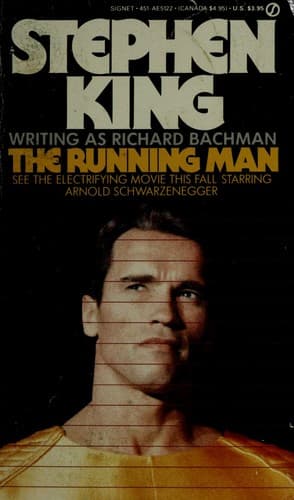
Book details and cover from Google Books.
Ready to read The Running Man?
Get your copy on Amazon, or listen to it on Audible. We earn a commission if you buy through these links.