
We earn a commission if you buy through these links. Learn more
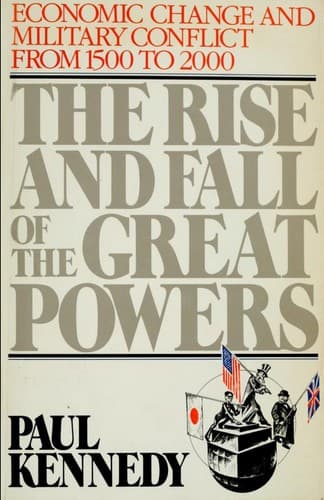
The Rise and Fall of the Great Powers
A sweeping, data-driven argument that great powers decline when military commitments outrun the economic base beneath them, still central to debates about American decline.
What It's About
Paul Kennedy's book, first published in 1987, asks why some states rise to dominance and others slide, and it answers with a long view that starts in 1500 and runs toward the late twentieth century. Kennedy is a historian rather than an economist, but he leans heavily on economic and military statistics, tracking how productive capacity, trade, and spending on armies and navies shifted among the major powers over centuries.
His central tool is the idea of imperial overstretch: a state takes on security obligations and territorial commitments that its resource base can no longer cover. Spain under the Habsburgs, the Dutch Republic, France, and Britain each serve as case studies in how wealth and power can drift apart, often because a country keeps spending on wars that its growth cannot sustain.
Reading it feels like sitting through a broad seminar lecture. Chapters move quickly through wars, treaties, and economic cycles, and the argument builds through comparison rather than narrative drama. The prose is clear and the book is accessible, but the statistical tables reward patient attention, and the final sections on the superpower rivalry of the 1980s have a distinctly period feel.
Read this if you…
- want a big-picture explanation of why empires rise and fall that rests on economic evidence
- are following current debates about American decline or China's rise and want the historical background
- enjoy comparative history that moves across several centuries and many countries
Skip it if you…
- want a narrative history with vivid individual characters and dramatic scenes
- are looking for a detailed account of any single war, country, or period
Key Ideas
- 1
The economic base sets the ceiling on power
Kennedy's starting assumption is that military strength rests on productive capacity. A state's ability to field armies and fleets depends on how much wealth it can generate and tax, and he tracks how that balance moved between rivals across several centuries.
- 2
Imperial overstretch as the central danger
Great powers tend to acquire commitments faster than their economies can fund them. Kennedy argues that the gap between what a state tries to defend and what it can afford is the most common route to relative decline, and he returns to this pattern in case after case.
- 3
Relative decline matters more than absolute decline
A country can grow richer and still lose ground if its rivals grow faster. Kennedy focuses on shares of world production and relative standing, which explains why a power can feel secure at home while its position in the international order quietly erodes.
- 4
The guns-versus-butter trade-off over time
Heavy military spending can crowd out investment in the civilian economy that would have sustained future strength. Kennedy presents this tension as a recurring dilemma that governments have faced repeatedly, with outcomes that varied according to how they handled it.
- 5
Great wars as accelerants of change
Major conflicts can speed up shifts already underway by draining treasuries, reshuffling alliances, and rewarding some economies over others. Kennedy uses large wars as turning points that reveal which powers had the productive depth to endure them.
Limitations
Critics have argued that the book leans toward economic determinism, treating military outcomes as largely a function of production and money while giving less weight to ideology, leadership, geography, and chance. Its focus on great powers also sidelines smaller states and non-European societies in ways that some readers find narrow. Kennedy's closing predictions about American overstretch, written during the 1980s, did not unfold as he framed them in the following decade, so the final chapters read as a product of their moment.
Questions Readers Ask
- Is The Rise and Fall of the Great Powers still relevant today?
- Yes. Its framework of economic strength, military commitments, and relative decline is still used in debates about American power and China's rise. Its specific warnings about the late Cold War era read as dated, so treat the historical chapters as the lasting value and the final predictions as a snapshot.
- How does it compare to Jared Diamond's Guns, Germs, and Steel?
- Both are broad, long-range books about why some societies gained power over others. Diamond looks for deep environmental causes of early divergence, while Kennedy concentrates on the later competition among great powers and the economics of military spending. Kennedy is more focused on the modern state system.
- Published
- 1987
- ISBN
- 9783596149681
- Difficulty
- intermediate
- Category
- History
Book details and cover from Google Books.
Ready to read The Rise and Fall of the Great Powers?
Get your copy on Amazon, or listen to it on Audible. We earn a commission if you buy through these links.