
We earn a commission if you buy through these links. Learn more
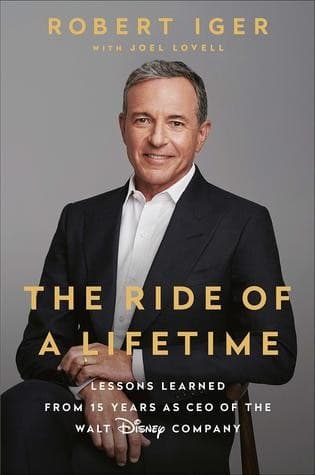
The Ride of a Lifetime
by Robert Iger
Guide by the Books of the Day editors · Updated · How we write our guides
A practical, first-hand account of how Disney's longtime chief made major acquisitions and bet on streaming, with leadership lessons that carry well beyond entertainment.
What Creators Say About The Ride of a Lifetime
2 creators reviewed The Ride of a Lifetime on YouTube in 2020, with 12.8K views between them. Their opinions are their own; we picked these reviews, we didn't write them.
What It's About
The Ride of a Lifetime is Robert Iger's account of his years running the Walt Disney Company, from becoming chief executive in 2005 through his departure in 2020. He spent decades inside ABC before taking over Disney, and the book is his attempt to explain the decisions that defined his tenure. The site files it under history, but it is better understood as a memoir with a business-leadership spine. It is most valuable as a firsthand record of how large media deals were weighed and made.
Rather than a strict chronology, Iger organizes the book around lessons he drew from specific episodes. The big ones include the purchases of Pixar, Marvel, and Lucasfilm, the push to build Disney's own streaming service, and the acquisition of much of 21st Century Fox. Each episode is used to explain a principle about judgment, risk, and managing creative people. The tone is measured, upbeat, and personal, with a steady emphasis on relationships and on staying curious.
Reading it feels like a long conversation with a careful, somewhat self-effacing executive who prefers to talk about how he thought through a choice rather than who he fought with. You get a clear sense of his priorities and his habits. You get less of the sharp, behind-the-scenes conflict that some readers hope for, so treat it as a considered self-portrait rather than an exposé.
Read this if you…
- want a first-hand view of how large media deals were evaluated and made
- lead or aspire to lead a large organization through a period of disruption
- are curious about the strategic reasoning behind Disney's shift to streaming
Skip it if you…
- want investigative detail on boardroom conflicts or the internal politics of the Eisner era
- are looking for a history of animation, Disney's origins, or the studio's early decades
Key Ideas
- 1
Betting on the future of how people watch
Iger's central case is that a legacy company has to move toward the way audiences are heading even when the current business still pays well. The book walks through the decision to launch a direct-to-consumer streaming service and the costs and uncertainties that came with it. It is a useful example of choosing a long-term shift over short-term comfort.
- 2
Buying creative companies and protecting their talent
The Pixar, Marvel, and Lucasfilm acquisitions are presented as bets on storytellers, not just on franchises. Iger explains why keeping founders and creative leaders engaged mattered as much as the purchase price. The lesson is that big deals in creative industries succeed or fail on whether the people who make the work stay motivated.
- 3
Deciding well with incomplete information
The book repeatedly stresses that major decisions rarely come with certainty, and that a leader has to act on partial data and then adjust. Iger describes how he tried to gather input, test assumptions, and remain willing to change course. Readers looking for a practical approach to high-stakes judgment will find plenty to think about here.
- 4
Optimism, curiosity, and staying close to the work
Iger treats optimism and curiosity as management habits rather than personality traits. He describes spending time with frontline staff and listening before deciding, which he presents as a way to catch problems early and find opportunities. These passages are more reflective than tactical, and they reward readers who like to think about leadership style.
- 5
Honoring a legacy while reinventing it
Disney is a company with an extraordinary history, and Iger wrestles with how much of that inheritance to preserve and how much to rebuild. He argues that respecting the brand's core meaning is compatible with bold change in how the work is made and distributed. This tension gives the book a thread that feels relevant to any organization carrying a famous past.
Limitations
The book is written by the executive himself, so it is favorable and selective by design. Controversies involving the company, including labor disputes and the handling of various political and cultural issues, receive limited scrutiny compared with what an independent author might give them. Some readers find the lessons familiar or the tone too polished. Because it was published in 2019, it does not cover Iger's return as chief executive in 2022 or the later changes in the streaming market, so its conclusions about streaming should be read as a snapshot of that moment.
Questions Readers Ask
- Is The Ride of a Lifetime really a history book?
- Not in the usual sense. Although the site lists it under history, it is a memoir with leadership lessons. It offers a firsthand record of events at Disney from 2005 to 2020, but it is Iger's personal interpretation rather than an independent historical account, so it is best read as a primary source with a clear point of view.
- Who is this book best suited for?
- It suits readers interested in business leadership, media strategy, or how big acquisitions are handled from the top. You do not need any background in entertainment. Readers who want a critical, investigative account of Disney will likely find it too guarded, but those who want a thoughtful executive's reasoning will get a lot out of it.
- How does it compare to other executive memoirs?
- It is more reflective and less combative than many CEO memoirs, which tend to focus on rivalries and settling scores. Iger concentrates on the reasoning behind his big decisions and on how he managed people. If you want more candor about conflict, you may prefer a memoir that is willing to name names and dwell on disputes.
- Published
- 2019
- ISBN
- 9780593170984
- Difficulty
- beginner
- Category
- History
Book details and cover from Google Books.
Ready to read The Ride of a Lifetime?
Get your copy on Amazon, or listen to it on Audible. We earn a commission if you buy through these links.