
We earn a commission if you buy through these links. Learn more
The Remains of the Day
On screen: The Remains of the Day (film, 1993)
Guide by the Books of the Day editors · Updated · How we write our guides
A quietly devastating novel about a butler whose formal, careful narration reveals far more than he intends, rewarding readers who enjoy what goes unsaid.
What Creators Say About The Remains of the Day
2 creators reviewed The Remains of the Day on YouTube between 2017 and 2022, with 346.6K views between them. Their opinions are their own; we picked these reviews, we didn't write them.
What It's About
The Remains of the Day is narrated by Stevens, an English butler who has spent decades in service at Darlington Hall. In 1956, with his former employer dead and the house sold to an American, he sets out by car on a short trip to the West Country to see Miss Kenton, the former housekeeper he once worked alongside. Along the way he remembers the years before, when the house hosted political gatherings in the run-up to the war.
The voice is the book's real achievement. Stevens is formal, precise, and almost comically earnest, explaining at length what makes a great butler and what dignity demands. Gradually the reader sees what he will not say: about his employer's choices, about his own life, and about the people he kept at a distance. Ishiguro builds the novel from its gaps, so reading it feels less like following a plot and more like noticing what a narrator is avoiding.
It is a short, quiet, melancholy book, with humor that comes from Stevens's blind spots. Expect little action and long reflective stretches about service, memory, and self-deception. It rewards slow, attentive reading, and it stays with you after the last page.
Read this if you…
- want a melancholy, precise novel about regret and missed chances
- enjoy books where the narrator's blind spots carry the story
- are interested in duty, class, and the British country house world
Skip it if you…
- need fast plot, strong momentum, or a clear sense of progress from chapter to chapter
- find formal, deliberately indirect narration frustrating rather than revealing
Key Ideas
- 1
Dignity as a professional identity
Stevens measures greatness in terms of professional dignity, the ability to keep feelings hidden and to serve without question. His definition of a good life is narrow, and the book slowly shows what that narrowness costs him. Watching him defend this ideal is the core pleasure of the novel.
- 2
Loyalty to a flawed employer
Stevens's duty to Lord Darlington keeps him from judging his master's political decisions, even as their consequences become clearer to the reader. The book asks how much responsibility a servant bears for the choices of the people he serves, and whether obedience can be a moral position.
- 3
An unreliable narrator
Stevens tells his story with great confidence, but his omissions and rationalizations expose him. The real drama lies in the distance between what he reports and what he seems to feel, which makes the reader an active interpreter rather than a passive listener.
- 4
Love left unspoken
His relationship with Miss Kenton is built on restraint, shared work, and things never said aloud. Ishiguro handles this thread with great delicacy, so its emotional weight comes from what is missing rather than from any declaration.
- 5
Memory and a vanishing England
The journey through the English countryside frames a larger reckoning with a social order that is fading after the war. Stevens's nostalgia for a grand house and a clear hierarchy is both touching and limited, and the novel examines that longing with clear eyes.
Limitations
The novel moves slowly, and its long reflective passages can feel repetitive to readers expecting drama. Its focus is narrow: a single upper-class household and a servant's inner life, with women and working-class characters mostly seen from a distance. Some readers find Stevens's self-regard hard to bear, and others feel the political background is handled with restraint that softens its moral stakes. The mannered style is central to the book, so it is not a flaw that can be fixed without changing the novel.
Questions Readers Ask
- Is The Remains of the Day worth reading if I usually prefer plot-driven novels?
- It can be, but go in expecting a character study rather than a story with momentum. The journey and the flashbacks are simple, and the pleasure comes from Stevens's voice and the gaps in his account. If you enjoy noticing what a narrator avoids, you will likely find it rewarding. If you need the plot to pull you forward, consider a shorter, faster book first.
- Should I watch the 1993 film before or after reading the novel?
- Read the novel first if you can. The 1993 film, starring Anthony Hopkins and Emma Thompson, is well regarded and faithful in spirit, but the book's inner narration is what makes its restraint so affecting. Seeing the film first can make the book's surprises feel less personal, since much of the subtext is carried by Stevens's voice on the page.
- Published
- 1989
- ISBN
- 9780571322732
- Difficulty
- intermediate
- Category
- Fiction
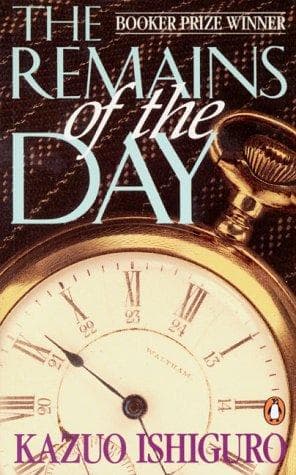
Book details and cover from Google Books.
Ready to read The Remains of the Day?
Get your copy on Amazon, or listen to it on Audible. We earn a commission if you buy through these links.