
We earn a commission if you buy through these links. Learn more
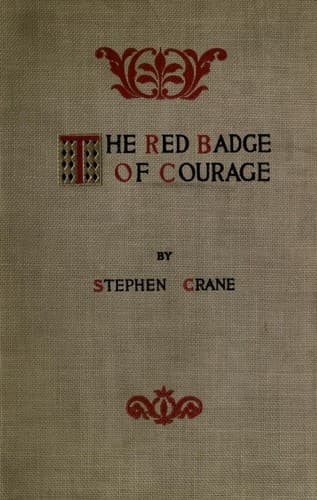
The Red Badge of Courage
A short Civil War novel that puts you inside one frightened young soldier's head, making it one of the sharpest studies of fear and self-deception in American fiction.
What It's About
The Red Badge of Courage is a short novel from 1895 set during the American Civil War. It follows Henry Fleming, a young Union private who enlisted expecting glory and who, in his first real battle, runs from the fighting before he turns back. Stephen Crane was born after the war and had never seen combat, yet the book reads as though its author had lived through every confused hour of it.
The style is the main event. Crane writes in short, hard sentences heavy with color and sensation, and he often leaves out the names of regiments, generals, and places, so the battle feels like a fog seen from inside one frightened head. Dialogue is sparse. The narrator reports what Henry sees and feels, then moves on, which makes the book feel fast and jumpy, more like a series of snapshots than a smooth chronicle.
Reading it is less like following a war story than like watching a mind argue with itself. Henry builds excuses, drops them, and builds new ones, and much of the drama lies in what he tells himself about his own courage. The book is brief enough to finish in an evening, but its images and rhythms are dense, and it rewards slow reading and a second pass.
Read this if you…
- want a short, intense novel about fear and self-deception
- are curious how literature changed the way war was written
- enjoy vivid, impressionistic prose and don't mind gaps in the story
Skip it if you…
- want a clear, big-picture account of the Civil War's campaigns
- need a fast plot with clear heroes and tidy moral lessons
Key Ideas
- 1
Courage as a story we tell ourselves
Henry's sense of himself depends on what he imagines others think and on the myths of heroism he absorbed before enlisting. Crane shows courage as partly a matter of reputation and self-image, which makes Henry's shifting judgments of himself the real engine of the book. Watching him reinterpret his own behavior is one of the book's most lasting pleasures.
- 2
Fear experienced as a physical event
Crane treats fear less as a moral failing than as something the body does: the pounding heart, the urge to run, the sense of being carried by forces one cannot control. Rather than explaining these reactions, he renders them through sensation. The result is a portrait of fear that feels immediate and unsentimental, which is why it still lands with readers today.
- 3
War seen from the ground level
Henry rarely sees the larger picture, so the reader does not either. Maneuvers, strategy, and the purpose of the fighting stay mostly out of view, and what remains is noise, smoke, confusion, and rumor. This narrow vantage is a deliberate choice that shapes the whole experience and challenges the grand, orderly way many war stories present battle.
- 4
Impressionist prose as a moral lens
Crane's imagery, often vivid and sometimes almost painterly, can make the natural world look beautiful while the men beneath it suffer. Fragmented scenes and repeated images mirror Henry's disorientation. Readers who enjoy close attention to language will find that the style is not decoration but the main way the book thinks about war.
Limitations
Crane's battle scenes are not reliable military history. He drew on accounts and imagination rather than firsthand experience, and the book's geography and tactics are vague by design. Some readers find the prose mannered, with heavy repetition of color words and nature imagery that can feel overwrought. Henry is a limited and often unappealing protagonist, and the novel suggests more about his psychology than it explores it. It also says little about slavery, politics, or the broader causes of the war.
Questions Readers Ask
- Is The Red Badge of Courage a history book?
- No, despite the category it is filed under, it is a novel. Crane invented its battles and its characters. It captures the feel of soldiers' experience in the Civil War rather than the facts of specific campaigns, so readers wanting historical accuracy should pair it with a nonfiction account of the war.
- How does it compare to All Quiet on the Western Front?
- Remarque's 1929 novel covers World War I from the German side and is more direct and explicit about the cost to ordinary men. Crane's book is shorter, more impressionistic, and focused on one soldier's inner doubt. Read Remarque if you want a broader, more emotionally open war novel, and Crane if you want a compressed study of a single mind under fire.
- Is it still worth reading today?
- Yes. Its study of fear, reputation, and self-justification is not tied to one war, and its experimental style influenced many later writers. Its language can feel demanding at first, but the book is short, so the time investment is modest for what it gives back.
- Published
- 1855
- ISBN
- 9780554347363
- Difficulty
- intermediate
- Category
- History
Book details and cover from Google Books.
Ready to read The Red Badge of Courage?
Get your copy on Amazon, or listen to it on Audible. We earn a commission if you buy through these links.