
We earn a commission if you buy through these links. Learn more
The Prophet
A short, lyrical set of reflections on love, work, sorrow, and freedom, worth an afternoon for anyone who wants wisdom in compact, musical form rather than a story.
What It's About
The Prophet is a slim book first published in 1923. A man named Almustafa has spent twelve years in the city of Orphalese and is about to sail home. Before he leaves, the townspeople gather and ask him to speak about the large questions of ordinary life. Each answer is a short prose poem, about two dozen in all, covering subjects such as love, marriage, children, work, giving, pain, and death.
Gibran writes in rhythmic, incantatory sentences built on paradox and balanced pairs. The result reads closer to scripture or parable than to a conventional novel. There is almost no plot, few characters beyond the speaker and the crowd, and little sense of place. The pleasure lies in the cadence and in the way familiar truths are turned slightly so they feel newly sharp.
Reading it feels more like listening to a sermon in a language you love than working through a book of argument. It takes an hour or two to finish, and it is easy to return to a single section when a particular situation calls for it. Some readers find its tone sweetly consoling; others find it repetitive or vague. Both reactions are fair.
Read this if you…
- want a short, consoling book you can finish in one sitting
- enjoy lyrical, aphoristic prose and like to read slowly for the sound of the sentences
- are looking for a gentle, non-doctrinal entry point into spiritual reflection
Skip it if you…
- want a story with characters, conflict, or a plot
- find sweeping statements about love and freedom too general to act on
Key Ideas
- 1
Paradox as a way of seeing
Gibran repeatedly pairs opposites such as joy and sorrow, or giving and receiving, to argue that they are not enemies but one force seen from two sides. Much of the book's effect comes from this habit of reframing, which can feel either illuminating or glib depending on how you respond to it.
- 2
Love that leaves room
The sections on love, marriage, and children argue that closeness should not mean possession. Each person is treated as a separate being on a shared path, and the book suggests that holding on too tightly undermines the very bond it hopes to protect.
- 3
Ordinary work as spiritual practice
Labor, generosity, and daily living are presented as meaningful acts rather than distractions from the sacred. The book's view is that how you build a house or share a meal matters as much as any formal devotion.
- 4
Wisdom that cannot be handed over
The speaker declines to issue final answers. He insists that understanding grows from within the listener, and that a teacher can only point toward it. This modesty is one of the book's quieter and more durable lessons.
- 5
Sorrow and death within a larger whole
Pain and mortality are treated as parts of a continuous cycle rather than as failures or endings. Readers who are grieving often find these passages the most consoling, though those looking for a detailed account of loss may find them abstract.
Limitations
The aphorisms are often broad and can be easy to agree with without it costing much. Readers who want argument, evidence, or practical guidance will find little of that here. Gibran's language sometimes sounds archaic, and his views on women, marriage, and family reflect the early twentieth century. Because the book has been quoted so often at weddings and in greeting cards, some readers come to it already tired of its phrases, which can dull its effect.
Questions Readers Ask
- Is The Prophet a novel?
- No. Although it is often catalogued as fiction, it is a collection of prose poems with a thin framing device. There is no plot in the usual sense. Readers who expect a narrative with characters and development will be disappointed, but those who approach it as a sequence of spiritual meditations will find it easier to appreciate.
- Is The Prophet still worth reading today?
- Yes, if you come to it for its tone and its consoling reflections rather than for new ideas. Its treatment of love, work, and grief still resonates with many readers. It is best read slowly and in small amounts, since its repetitive rhythm can wear thin over a long sitting.
- Published
- 1923
- ISBN
- 9798432076724
- Difficulty
- beginner
- Category
- Fiction
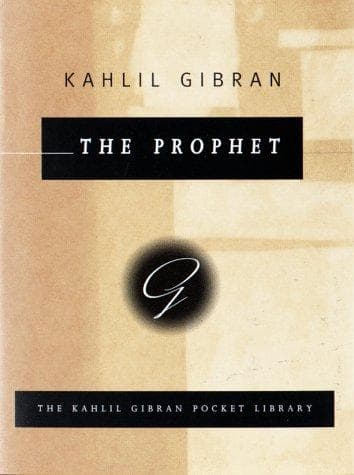
Book details and cover from Google Books.
Ready to read The Prophet?
Get your copy on Amazon, or listen to it on Audible. We earn a commission if you buy through these links.