
We earn a commission if you buy through these links. Learn more
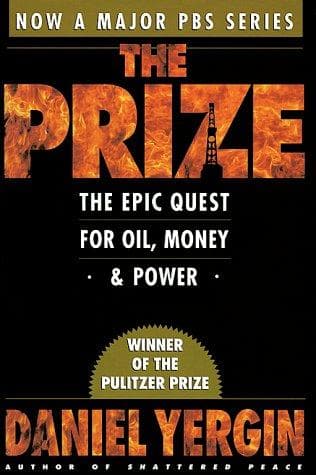
The Prize
Daniel Yergin's Pulitzer-winning history links Pennsylvania's first oil wells to the 1973 embargo, showing how a single commodity came to shape war, diplomacy and modern economies.
What It's About
The Prize is a sweeping narrative history of the oil industry, told as the story of how a commodity that began as lamp fuel in nineteenth-century Pennsylvania became the lifeblood of modern war, diplomacy and economics. Yergin follows three intertwined strands: the American rise and breakup of Standard Oil, the Russian and Soviet fields around Baku, and the British and American scramble for Middle Eastern concessions that eventually produced OPEC. Each strand is driven by vivid characters, including oilmen, statesmen and rulers, whose decisions shaped how the world's supply was found, controlled and sold.
The approach is journalistic and chronological, with a strong sense of momentum. Yergin writes in scenes, moving between boardrooms, battlefields and oil fields, and he keeps returning to a few recurring questions: who controls supply, who sets the price, and what happens when governments decide oil is too important to leave to companies. The book is long and dense with names and deals, but it rarely feels like a dry ledger because the stakes stay visible.
Reading it is less like studying a single argument than following a chain of events in which each crisis explains the next. By the time you reach the price shocks of the 1970s, you understand why governments and companies behave as they do and why the modern energy market looks the way it does. It rewards patience and a willingness to hold many countries and companies in mind at once.
Read this if you…
- want a big-picture history of how oil shaped twentieth-century politics and war
- enjoy narrative history built around powerful personalities and high-stakes deals
- are trying to understand why energy markets and Middle East politics work the way they do
Skip it if you…
- need a current account of energy markets, climate policy or the energy transition
- want a short book, since this is a long, detailed history with many names to track
Key Ideas
- 1
Oil as a strategic resource, not just a product
The book's central argument is that oil became a political object as soon as navies, armies and industrial economies depended on it. Yergin traces how the decision to switch naval fleets from coal to oil bound the state to the fuel, and how later governments came to treat access to supply as a question of security. Once that happened, commercial decisions by companies could no longer be separated from diplomacy.
- 2
Cartels and the struggle to control prices
Much of the book explores attempts to bring order to a market prone to gluts and shortages. Standard Oil's dominance and its breakup show one answer; the major international companies coordinating through concessions, and producing countries later forming OPEC, show another. Yergin argues that the fight over pricing power repeats across generations, with each arrangement eventually undone by its own success.
- 3
Nationalism and the shift of power to producers
The story moves from foreign companies that found and developed fields to governments that wanted a larger share of the wealth beneath their soil. Yergin shows how concession agreements gave way to nationalization and partnership deals, and how the 1973 embargo and price surge marked the moment producing states gained the upper hand. That shift reshaped how the industry worked for decades afterward.
- 4
How cheap oil made the modern world seem inevitable
A valuable theme is the way abundant, inexpensive oil came to feel like a natural fact of life. Yergin treats the energy system as something built through contingent choices rather than destiny, and asks readers to see how dependence was chosen and defended. This framing stays useful for thinking about current energy debates, even though the book's coverage ends well before them.
Limitations
The book was published in 1991, so it stops well before the price collapses of the late 1990s and 2000s, the shale boom, and the climate debate that now dominates energy policy. Yergin later wrote a follow-up that brings the story forward, which is worth reading alongside it. Critics have also said the account leans toward the perspective of Western companies and governments, giving less space to ordinary workers, consumers and the producing societies that bore many of the costs. Some readers find the sheer number of deals and figures exhausting.
Questions Readers Ask
- Is The Prize still relevant today?
- Yes, for understanding the history behind today's oil markets and geopolitics, though not for current data. The structure of the industry, the role of OPEC and the link between oil and national security are still easy to trace back to the events Yergin describes. For current prices, production or climate policy, you will need to look elsewhere or read his later book.
- How does it compare to other oil histories?
- The Prize is broader than most. Where many oil books focus on a single company, country or crisis, Yergin ties the American, Russian and Middle Eastern stories into one narrative. That breadth is its strength, though readers wanting deep detail on one region may find more specialized studies more satisfying.
- Published
- 1991
- ISBN
- 9781439110126
- Difficulty
- intermediate
- Category
- History
Book details and cover from Google Books.
Ready to read The Prize?
Get your copy on Amazon, or listen to it on Audible. We earn a commission if you buy through these links.