
We earn a commission if you buy through these links. Learn more
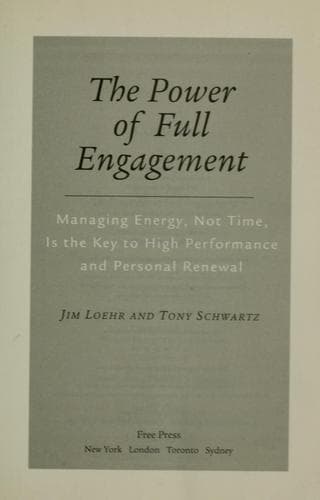
The power of full engagement
A practical, sports-psychology take on why managing your energy in cycles of effort and recovery works better than squeezing more hours out of the day.
What It's About
The book's central argument is that time is a fixed resource while energy can be renewed, and that most performance problems come from spending energy faster than it is restored. Jim Loehr, a sports psychologist who spent decades working with athletes and later with business executives, wrote it with journalist Tony Schwartz. Together they build a framework around four sources of energy: physical, emotional, mental, and spiritual.
The approach is the most distinctive part. Rather than urging you to work harder or organize your calendar more tightly, the authors recommend alternating intense focus with deliberate recovery, the way elite athletes train, and building regular routines that make healthy behavior less dependent on willpower. The style is brisk and anecdotal, drawing on stories from sport and corporate clients, with short sections and summary points.
Reading it feels like a motivational workshop condensed into a short book. It is quick to finish and easy to act on, and many readers leave with a few routines to test rather than a new theory of work. Expect encouragement and practical framing more than deep analysis.
Read this if you…
- feel busy and depleted and want practical routines rather than abstract theory
- are an athlete, coach, or manager curious how sports training applies to everyday work and life
- want a short, accessible read that you can start putting into practice this week
Skip it if you…
- want rigorous research or an evidence-heavy argument with careful citations
- are looking for a critique of workplace demands or the structural causes of burnout
Key Ideas
- 1
Energy, not time, is the limiting resource
The authors argue that the hours in a day are fixed, so the real constraint is how much capacity you bring to each hour. Focus, patience, and judgment fade with depletion, which means a full calendar can still produce weak work. Shifting attention from scheduling to energy changes which problems you try to solve first.
- 2
Four dimensions of energy to manage
Physical energy covers sleep, nutrition, and movement. Emotional energy concerns how you handle pressure and whether you can access positive feelings. Mental energy is focus and clarity, and spiritual energy is tied to purpose and values. The framework is useful because it shows that a problem in one area can quietly drain the others.
- 3
Alternating stress with deliberate recovery
Drawing on the training logic of athletes, the book describes a pulse of intense effort followed by real rest. Recovery is treated as part of performance rather than a reward for finishing work. The idea challenges the habit of pushing continuously and then wondering why energy collapses.
- 4
Rituals turn good intentions into habits
Loehr and Schwartz propose building specific, repeatable routines for sleep, eating, breaks, and daily priorities. Once these are automatic, they require less willpower, which matters most when you are tired or under pressure. The emphasis is on small, concrete behaviors rather than broad resolutions.
Limitations
The evidence is largely anecdotal, drawn from the authors' work with athletes and clients, and the book has been criticized for presenting ideas from sport as if they transfer neatly to office life. Its focus on personal energy management can place responsibility on the individual, with little attention to workload, pay, caregiving, or unequal circumstances. The corporate tone and prescriptive lists may feel generic to some readers, and later research on sleep, stress, and recovery has added nuance the book does not reflect.
Questions Readers Ask
- Is it worth reading if I already know the basics of sleep and exercise?
- Partly. Much of the health advice is familiar, but the book's value lies in framing sleep, food, movement, and emotional state as parts of one system, and in its approach to building routines. If you already keep those habits, you may skim the early material and spend more time on the sections about rituals and recovery.
- How does it compare to Atomic Habits?
- Atomic Habits by James Clear focuses broadly on how habits form and change. The Power of Full Engagement is narrower and more concerned with energy, recovery, and performance under pressure. Clear offers more systematic guidance on building habits, while Loehr's book is more tied to the physical and emotional side of sustained effort.
- Published
- 2003
- ISBN
- 9780743226745
- Difficulty
- beginner
- Category
- Self-Improvement
Book details and cover from Google Books.
Ready to read The power of full engagement?
Get your copy on Amazon, or listen to it on Audible. We earn a commission if you buy through these links.