
We earn a commission if you buy through these links. Learn more
The philosophy book
by Will Buckingham, DK Publishing
A clear, illustrated map of Western philosophy from the ancient Greeks to recent debates, useful for orienting yourself before you read the thinkers themselves.
What It's About
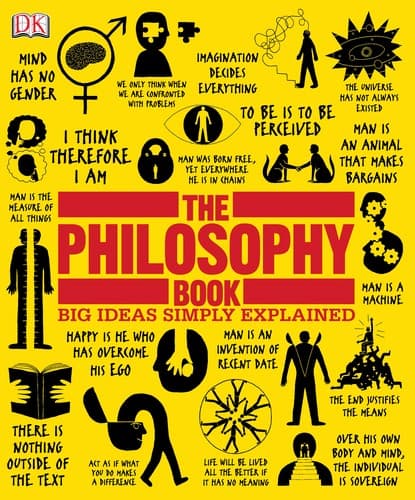
The Philosophy Book is a large illustrated survey from DK, led by Will Buckingham, that tours philosophy from early Greek thinkers to modern and contemporary debates. It is built less as one continuous argument than as a reference guide: short entries on thinkers, schools, and key concepts, arranged roughly in historical order and supported by timelines, portraits, and sidebars that place each idea in its time.
Reading it is closer to browsing than to reading straight through. Each entry offers a compact explanation of a recurring question, such as what can be known, what makes an action right, or what a mind is, and then shows how different answers developed and argued with one another. The prose is plain and the layout does much of the work, so the subject feels approachable even if you have never opened a philosophy text. Because entries are brief, you come away with orientation rather than depth.
Its real value is as a map. If you want to see where Plato, Descartes, Kant, or Wittgenstein sit in relation to one another, or you need a quick grip on a term you keep meeting in articles and podcasts, it gives you a reliable starting point. It works best as a first stop, with longer books picked up afterward for the parts that catch your interest.
Read this if you…
- want a visual overview of philosophy's major figures and schools
- are starting out and want to see how ideas connect before tackling primary texts
- prefer to dip into topics in any order rather than read one argument from start to finish
Skip it if you…
- want a single line of argument or sustained engagement with one philosopher
- already studied philosophy and are looking for rigour, close reading, or new interpretations
Key Ideas
- 1
Philosophy as a set of recurring questions
The book keeps returning to a handful of enduring problems: what exists, how we come to know anything, what counts as a good life, and how a society should be organised. Seeing these as stable questions, rather than a list of unrelated opinions, is the main lesson. Each era gets its own answers, and the book helps you notice when a modern debate is really an old one in new clothing.
- 2
Schools defined by their rivalries
Movements such as rationalism and empiricism, idealism and materialism, or existentialism and analytic philosophy are presented as responses to one another. The book makes clear that many schools were formed in argument with a predecessor. This framing helps readers understand why a philosopher's position looks odd until you know what it was reacting against.
- 3
Thinkers placed in their historical context
Philosophers are shown responding to science, religion, politics, and social upheaval rather than floating above them. Timelines and sidebars show what else was happening in a given century. This context makes abstract positions easier to remember because you see the pressures that produced them.
- 4
Key terms you can actually use
Specialist vocabulary such as epistemology, phenomenology, or categorical imperative is explained briefly and in ordinary language. The entries are useful as a glossary for everyday reading. They will not give you the nuance a seminar would, but they will stop jargon from blocking you in conversation or in other books.
Limitations
The book leans heavily on the Western tradition, so readers looking for a broad global survey will find it narrow. Its brevity means many thinkers and debates get only a sentence or two, which can flatten real disagreements. Some entries on contemporary analytic philosophy feel thin compared with the historical material. The busy page design suits browsing but can make sustained reading tiring. Treat it as an introduction and check the specifics against fuller sources before relying on them.
Questions Readers Ask
- Is The Philosophy Book suitable for a complete beginner?
- Yes. It assumes no background and explains terms in plain language, with visual aids that help you place each idea. It suits readers who want orientation before committing to longer books. If you want to be challenged by the arguments themselves, you will need to move on to primary texts or more detailed introductions after reading it.
- How does it compare with Bryan Magee's The Story of Philosophy?
- Magee's book is a narrative, with longer discussions that follow a chain of ideas from one thinker to the next. The Philosophy Book is more of a reference, with short entries and strong visuals. Choose Magee if you want to read something like a story, and this one if you prefer to jump around and look things up.
- Published
- 2011
- ISBN
- 9780756668617
- Difficulty
- beginner
- Category
- Introductions
Book details and cover from Google Books.
Ready to read The philosophy book?
Get your copy on Amazon, or listen to it on Audible. We earn a commission if you buy through these links.