
We earn a commission if you buy through these links. Learn more
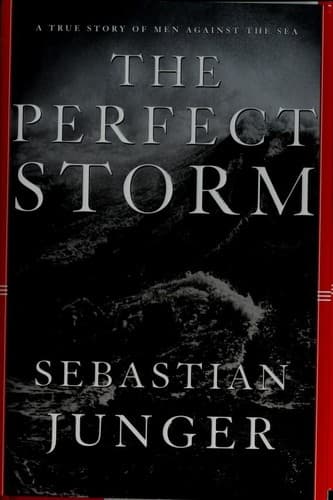
The Perfect Storm
by Sebastian Junger, Anne Collins
Guide by the Books of the Day editors · Updated · How we write our guides
A gripping reconstruction of the Andrea Gail's final voyage, where a swordfishing crew met an unusually deadly convergence of storms, and a clear look at how weather, money, and risk combine.
What It's About
The Perfect Storm is Sebastian Junger's 1997 account of the Andrea Gail, a swordfishing boat out of Gloucester, Massachusetts, that was lost at sea in October 1991 after running into a rare convergence of weather systems off Nova Scotia. Because no crew member survived, Junger rebuilds the final days from interviews with families and fishermen, weather records, and the rescue efforts that unfolded nearby.
The approach mixes narrative and reportage. Junger moves between the crew's working lives, the meteorology that produced the storm, and the history of swordfishing on the Grand Banks, often jumping to a rescue crew or a Coast Guard operation. The prose is brisk and vivid, and the storm sequences carry real tension even though the outcome is clear from the start.
Reading it feels like spending a season at sea with people who make a living by taking chances, then waiting onshore with the people who love them. It is short enough to finish in a few sittings. It is narrative nonfiction rather than a technology book, despite the category listed here, though it contains plenty of technical material explained for general readers.
Read this if you…
- are curious how a disaster forms from several small failures rather than one mistake
- want a true story with strong momentum, vivid sea scenes, and a clear sense of place
- enjoy technical detail about weather and boats when it is explained for non-specialists
Skip it if you…
- want a fully sourced investigation with new findings, since this is largely a reconstruction from interviews and public records
- dislike digressions, because the side stories about other rescues and the author's own sea experiences can slow the pace
Key Ideas
- 1
Several ordinary forces combining into disaster
The tragedy did not come from one error. Junger shows how separate weather systems merged into an unusually violent sea, turning conditions that a sturdy boat might have survived into a fatal combination. The book is a study in how bad luck, timing, and geography can line up.
- 2
Money as a force pushing men to sea
Fishing crews are often paid by a share of the catch, so a trip is a financial gamble as well as a job. Junger uses the crew's circumstances to explain why men accepted dangerous voyages, and why turning back was rarely a simple choice for those on board.
- 3
The limits of forecasting in 1991
The book examines what forecasters and captains knew and did not know as the storm developed. It is a useful reminder that weather prediction was far less precise then, and that decisions made at sea depend heavily on incomplete information arriving late.
- 4
A coastal town defined by the sea
Junger spends time on Gloucester's maritime culture, including its families, rituals, and expectations. The sea is not just a setting here but the central fact of people's lives, which gives the disaster a weight beyond the single boat.
Limitations
Critics point out that, with no survivors among the crew, the inner lives of the men are inferred from family members and acquaintances, so some portraits feel thinly drawn. Some readers find the tangents into other rescues and Junger's own sea experience uneven in pacing. The book dates from the late 1990s, so its discussion of fisheries and forecasting does not reflect later management rules or modern tools. The 2000 film adaptation simplified and dramatized many elements, which can color expectations.
Questions Readers Ask
- Is The Perfect Storm still worth reading?
- Yes, mainly for the storytelling and the questions about risk, work, and decision-making at sea. Some weather and fishing details reflect the 1990s, but the narrative holds up well and remains one of the best-known examples of popular disaster reporting.
- How does it compare to Into Thin Air?
- Both are gripping disaster narratives about people who chose dangerous work. Krakauer's Into Thin Air is first-person and drawn from his own experience on Everest. Junger's book is a reconstruction without survivors, with a wider focus on weather systems, fishing economics, and the town the crew came from.
- Published
- 1997
- ISBN
- 9780786212170
- Difficulty
- beginner
- Category
- Tech
Book details and cover from Google Books.
Ready to read The Perfect Storm?
Get your copy on Amazon, or listen to it on Audible. We earn a commission if you buy through these links.