
We earn a commission if you buy through these links. Learn more
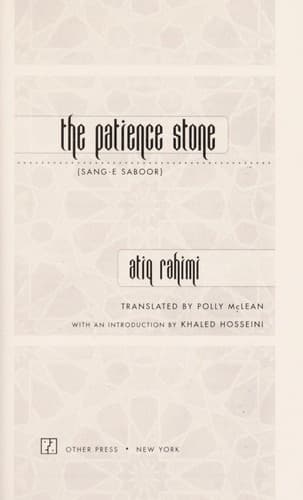
The patience stone
by Atiq Rahimi
Guide by the Books of the Day editors · Updated · How we write our guides
A short, claustrophobic novel built from one woman's monologue to her comatose husband, it turns a single room in wartime Afghanistan into a frank study of silence, confession, and survival.
What Creators Say About The patience stone
2 creators reviewed The patience stone on YouTube between 2010 and 2013, with 338.7K views between them. Their opinions are their own; we picked these reviews, we didn't write them.
What It's About
The Patience Stone is a short novel by Atiq Rahimi, who wrote it in French and later published it in English in a translation by Polly McLean. Nearly all of it takes place in one room in an unnamed city during a war. A young woman sits beside her husband, a fighter who lies unconscious after being shot in the neck, and tends to him while gunfire and shelling continue outside.
The book is a monologue addressed to the man who cannot answer. Drawing on an old idea that a patience stone can absorb whatever is told to it until it finally breaks, the woman begins to speak about things she has never been allowed to say: her marriage, her fears, and the hard facts of her life under a violent and controlling household. The voice moves between resentment, tenderness, bluntness, and lyricism, and it is never quite clear how much the woman is confessing and how much she is performing.
Reading it is intense and unsettling. The heat, the flies, the failing body, and the close quarters press in on you, and the prose is compressed enough that you finish it in a single long sitting. It rewards close attention rather than fast plot-following, and it leaves you thinking about what a person can say once there is nobody left to stop them.
Read this if you…
- want a short, intense novel about women's lives under war
- enjoy literary fiction built on a single voice and a single setting
- are interested in Afghanistan seen from inside a private home rather than from the battlefield
Skip it if you…
- need a strong plot, many characters, or a steady sense of forward movement
- find graphic violence and sexual content hard to read, since the book deals with both directly
Key Ideas
- 1
Confession as a kind of freedom
The woman speaks because speaking is the only power left to her. The novel asks what happens when someone who has been silenced for years finally has a listener, even one who cannot respond. Her words gain force because they are unsafe to say aloud, and the book treats that risk as part of what she is claiming.
- 2
Women's silence inside a violent order
Rahimi shows how private life under patriarchy and armed conflict depends on women keeping quiet. Obedience, shame, and the expectation of endurance are built into the household, and the monologue exposes how these rules shape a woman's inner life as much as her outward conduct.
- 3
War as the backdrop of ordinary life
The fighting outside is rarely described in detail, yet it shapes every hour of the room. Rahimi keeps the war at the edge of the frame, so the reader feels its pressure through rationed time, uncertain safety, and the sense that personal disasters are routine and unremarkable.
- 4
Storytelling as both power and danger
Telling a story can release pressure, but it can also expose the teller. The novel is attentive to the tension between the need to speak and the cost of being heard, and it makes the act of narration itself a central subject rather than a neutral frame.
- 5
A single room as the whole world
Confining the action to one space and one voice gives the book its concentrated force. The form is spare and repetitive by design, so the reader experiences the same limits the character lives within, and the small changes in her speech carry much of the emotional movement.
Limitations
The Patience Stone is relentlessly bleak, and some readers find its single-voice structure repetitive or emotionally airless over its length. The city and the conflict are deliberately unnamed, so readers looking for political context or historical detail will find only what the characters glimpse. Because the story is filtered through one speaker, it offers a narrow view of Afghan society, and some critics have argued that its universal framing can blur specific cultural and historical realities. The novel is demanding rather than difficult in its language, but its emotional weight is considerable.
Questions Readers Ask
- Do I need to know about Afghanistan's history to understand The Patience Stone?
- No. The novel gives only the background it needs, and the war is felt rather than explained. Some background knowledge will add depth, especially to the cultural pressures on the woman, but the book stands on its own as a study of confinement, speech, and endurance.
- How does it compare to The Kite Runner?
- The Kite Runner is a wide, sprawling, plot-driven story spanning decades and two countries. The Patience Stone is compressed into one room and one voice, with far less plot and much more interior intensity. Readers who liked Hosseini's emotional storytelling may find Rahimi's book more austere and more challenging.
- Is it a good first novel to read about Afghan literature?
- It can be, since it is short and vivid. However, it is grim and formally unusual, so readers who want a gentler introduction might start with a more conventional narrative. It suits readers who are comfortable with difficult material and closely focused literary fiction.
- Published
- 2009
- ISBN
- 9781590513446
- Difficulty
- intermediate
- Category
- Fiction
Book details and cover from Google Books.
Ready to read The patience stone?
Get your copy on Amazon, or listen to it on Audible. We earn a commission if you buy through these links.