
We earn a commission if you buy through these links. Learn more
The Pale Horse
Guide by the Books of the Day editors · Updated · How we write our guides
A late Christie mystery that trades drawing-room puzzles for an eerie village, a list of names, and a question of whether the deaths are murder, coincidence, or something worse.
What Creators Say About The Pale Horse
2 creators reviewed The Pale Horse on YouTube between 2020 and 2023, with 5K views between them. Their opinions are their own; we picked these reviews, we didn't write them.
What It's About
The Pale Horse is built around a quiet unease. A few people die in ordinary-seeming ways, and a list of names surfaces that seems to link them. The writer Mark Easterbrook is drawn in because the deaths touch people he knows, and he begins to suspect that something in a village has gone wrong. Christie keeps the question open for a long time, asking whether this is a crime, a coincidence, or something stranger.
Stylistically it is more restrained than her famous country-house puzzles. The pace is steady, the dialogue is clipped, and much of the tension comes from a sense that the village itself is hiding something. Readers who expect a neat gathering of suspects will find something looser, with long stretches spent following rumour and small inquiries rather than interrogating a cast. The book leans toward atmosphere and the chill of a community that closes ranks.
What it feels like to read is a slightly eerie mystery where you are always one step behind the investigator's theories. It rewards attention to small details, such as who visits whom and what people choose not to say. It is short enough to finish in an evening and dense enough to reward a second read, especially if you already know Christie's later style.
Read this if you…
- enjoy slow-burning puzzles that favour atmosphere over a big reveal scene
- want to see how Christie's style shifted in her later career
- like village-set mysteries with a faint supernatural chill
Skip it if you…
- want a lively, witty whodunit with a colourful cast of suspects
- need a recurring detective like Poirot or Marple to anchor the story
Key Ideas
- 1
Ordinary deaths that might not be ordinary
Christie builds suspicion slowly from deaths that look natural or accidental. The central tension is whether anything is actually murder at all, and the book keeps you weighing each death on its own before the pattern becomes clear. The uncertainty is the engine of the story.
- 2
The village as a closed community
The setting does much of the work. A small place protects its own secrets through gossip, silence, and polite evasions, and the outsider's position makes every conversation feel like a negotiation. Readers who enjoy village mysteries will recognise how Christie uses local texture to hide and reveal information.
- 3
Rational detection against superstition
The book toys with witchcraft and occult belief, asking readers to decide what can be explained and what only feels uncanny. Christie treats belief seriously without endorsing it, and the friction between reason and suggestion is one of the book's most distinctive qualities.
- 4
Silence and behaviour as clues
People in this book often reveal more through what they avoid saying than through direct statements. Clues sit in habits, visits, and small inconsistencies rather than in confessions or big set-piece accusations, so attentive readers are rewarded.
Limitations
Character work is thinner than in Christie's best-known books, and some figures feel more like functions of the plot than fully realised people. The supernatural material is handled with a light touch that some readers will find unsatisfying. The book's views on class, gender, and rural life reflect 1960s assumptions. The middle can sag for readers used to tighter structures, and it is not a showcase for her most inventive plotting.
Questions Readers Ask
- Do I need to read Agatha Christie's earlier books first?
- No. The Pale Horse works as a standalone and has no recurring detective whose history you need to know. Some familiarity with Christie's style helps you notice how she handles misdirection and social detail, but it is not required to follow the story.
- How does it compare to And Then There Were None?
- And Then There Were None is tighter and more of a pure puzzle with a fixed cast in a closed setting. The Pale Horse is looser and more atmospheric, built around rumour and a village. If you loved the earlier book for its precision, you may find this one slower and more diffuse.
- Published
- 1952
- ISBN
- 9780553350463
- Difficulty
- beginner
- Category
- Mystery & Thriller
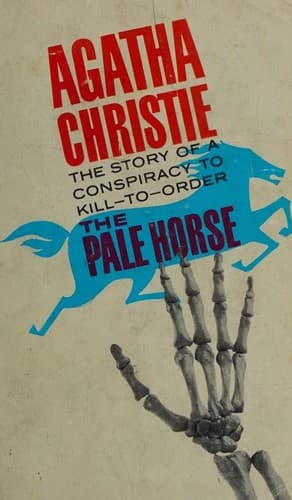
Book details and cover from Google Books.
Ready to read The Pale Horse?
Get your copy on Amazon, or listen to it on Audible. We earn a commission if you buy through these links.