
We earn a commission if you buy through these links. Learn more
The Painted Man
Guide by the Books of the Day editors · Updated · How we write our guides
A fantasy about three young people growing up in a world where demons rise every night and only painted wards keep people alive, with a slow, deliberate build that rewards patient readers.
What Creators Say About The Painted Man
2 creators reviewed The Painted Man on YouTube between 2015 and 2018, with 4.9K views between them. Their opinions are their own; we picked these reviews, we didn't write them.
What It's About
The Painted Man is the opening volume of Peter V. Brett's Demon Cycle, a fantasy series set in a world where people survive by hiding behind protective markings. After dark, demons called corelings rise from the ground and hunt anyone caught outside. The wards that keep them back are painted symbols that must be renewed constantly, so the question of how ordinary people live with that fear is as interesting to Brett as any plot.
The story follows three young people from different places as they grow up. Their paths stay separate for long stretches, which gives the novel a wide, almost panoramic feel. Each strand has its own texture: a village life shaped by fear and tradition, a harsher desert society with its own ideas about courage and honour, and a wandering performer's life on the roads. Brett moves between them in short chapters, and the reader slowly sees how these lives might connect.
Reading it feels like settling into a classic quest-style fantasy with a strong sense of place and a steady rise in tension. The prose is direct rather than ornate, and the early chapters favour world-building and character growth over large battles. Some readers will find the opening slow, but the rhythm of night and dawn becomes a backbone for the story. It is best approached as the first stage of a longer story rather than a complete one.
Read this if you…
- enjoy epic fantasy with several viewpoint characters and a large cast
- want a survival story built around a monstrous threat and a richly imagined setting
- like coming-of-age stories that follow characters over many years
Skip it if you…
- want a fast-paced plot that pays off from the first chapter
- need a self-contained novel with a fully resolved ending
Key Ideas
- 1
Fear as a daily routine
Brett treats nightly danger as ordinary life rather than a dramatic exception. Families plan their days around dusk, children learn the rules of the wards early, and the threat shapes marriage, work, and travel. The book is interested in how people normalise terror and still manage to build lives inside it.
- 2
Protection that must be maintained
The wards only work when they are kept fresh and correctly made, which turns safety into an act of constant upkeep. This makes the setting feel fragile in a concrete way. Any lapse in skill, supply, or attention can cost lives, and the idea of civilisation as a set of small, repeated tasks runs through the whole book.
- 3
Three cultures, three ideas of courage
Each main character comes from a society with different values about bravery, duty, and status. Comparing these worlds lets Brett question what courage means when the enemy comes every night. The contrasts also drive much of the story's tension and debate between its viewpoints.
- 4
Slow-build worldbuilding and gradual reveals
Brett releases information about the demons, the history of the world, and the reasons behind its customs at a measured pace. Readers who enjoy piecing together a setting from fragments will find this rewarding. Those who want answers quickly may find the withholding frustrating.
Limitations
Some readers find the opening slow, since the book spends considerable time on childhood and setup before the larger conflict takes shape. The prose is functional rather than memorable, and dialogue and secondary characters can feel conventional. Critics have also raised concerns about how the desert society portrays women and how gender roles are depicted. The novel does not resolve the central conflict, so it works best as the start of a longer series rather than a standalone reading experience.
Questions Readers Ask
- Who is The Painted Man best suited for?
- It suits readers who enjoy long, character-led epic fantasy and are willing to be patient in the early chapters. If you like monster-driven survival stories, cultures built on contrasting values, and a slow build toward larger conflict, you will probably enjoy it. Readers who want quick action or a neatly closed story may find it less satisfying.
- Is The Painted Man still worth reading today?
- Yes, especially if you like the structure of modern epic fantasy series. Its premise is still distinctive, and its focus on everyday survival remains appealing. The prose and pacing may feel dated compared with more recent bestsellers, but the world and its three main threads hold up well for readers who enjoy long series.
- How does it compare to The Wheel of Time?
- Both are long epic fantasies with multiple viewpoint characters and a sprawling sense of world. The Painted Man is tighter in focus, with a smaller, more immediate threat and a plainer style. Readers who found Robert Jordan's books too slow or too dense may appreciate Brett's more direct approach, though the series also asks for patience.
- Published
- 2001
- ISBN
- 9782352944928
- Difficulty
- intermediate
- Category
- Fantasy
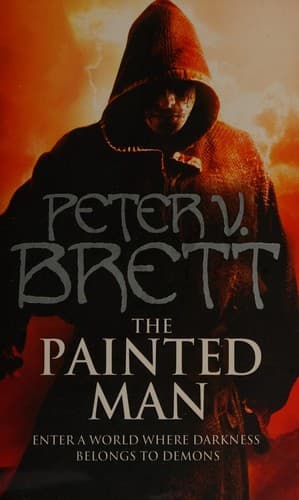
Book details and cover from Google Books.
Ready to read The Painted Man?
Get your copy on Amazon, or listen to it on Audible. We earn a commission if you buy through these links.