
We earn a commission if you buy through these links. Learn more
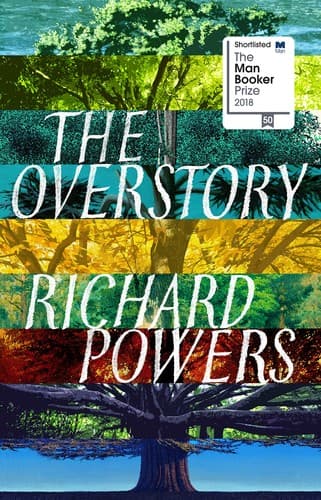
The Overstory
by Richard Powers, Richard Powers
Richard Powers's sprawling, Pulitzer-winning novel gathers strangers from very different lives into a slow, passionate case for trees and the people willing to fight for them.
What It's About
The Overstory is a long novel built in four parts, named for the layers of a tree: roots, trunk, crown, and seeds. It begins with a set of people who seem to have little in common, including a farm boy, a Vietnam veteran, a young programmer, an artist, and a scientist. Powers introduces each life separately, so the early chapters read almost like linked short stories. Their paths converge gradually around forests and the question of what humans owe to the living things that outlast them.
Much of the book's texture comes from its fascination with how trees live. Powers works in passages of botany and ecology, often slowing down to watch a single tree or a single gesture across decades. The prose is lyrical and occasionally sermonizing. The novel openly carries ideas alongside its characters, and it asks the reader to accept that the argument matters as much as the plot.
Reading it is a patient immersion rather than a page-turner. The early sections require trust, and the payoff arrives as the threads tighten and the question shifts from whether trees matter to what a person will risk for them. It rewards attention and often invites a second reading.
Read this if you…
- love novels that blend storytelling with real science and natural history
- are willing to spend a long stretch with slow, scattered characters before the story gathers force
- care about environmental questions and want them treated with emotional and moral seriousness
Skip it if you…
- need brisk plot and a clear protagonist from the first page
- find sermonizing or heavy didacticism in fiction hard to tolerate
Key Ideas
- 1
Trees as a different kind of life
The novel takes seriously the idea that trees are not inert scenery but slow, social, responsive organisms that operate on timescales human lives barely register. Powers uses this to unsettle the reader's sense of what counts as a life, and to make the destruction of old forests feel like the loss of a whole history rather than a pile of lumber.
- 2
Lives that only connect by accident
Each major character arrives at environmental concern through a separate path, shaped by family, injury, faith, technology, or grief. The book is interested in how ordinary people drift toward a cause, and how little of the process resembles a sudden awakening. The structure makes that drift visible.
- 3
Activism and its moral cost
A central strand asks what protest is worth when the stakes are existential and the institutions seem indifferent. Powers does not treat direct action as simple heroism. He lets the reader feel its appeal and its damage, and he keeps asking who pays for the choices people make in defense of nature.
- 4
Storytelling that mirrors its subject
The novel's structure borrows from the tree itself: roots that run underground, a trunk that gathers the separate branches, and seeds that scatter outward. Its repetitions and returns make the book feel grown rather than plotted, which is part of what makes it distinctive and part of what can frustrate readers who want tighter momentum.
Limitations
Critics often point to the book's length and its uneven pacing, especially in the opening sections, where the connection between characters is slow to form. Some readers find the characters more like representatives of positions than fully rounded people, and the lecturing passages on trees can feel insistent. The novel's depiction of activism has also drawn debate about how sympathetically it portrays violence. It is more interested in the American forest and its advocates than in broader global environmental politics, so readers looking for a wide survey of climate issues will find a narrower, more personal lens.
Questions Readers Ask
- Is The Overstory hard to get into?
- The opening is the hardest part. Each character's story is introduced separately, and the threads take a while to connect. Readers who stay past the first section usually find the structure rewarding. If you prefer a fast hook, expect to be patient for the first hundred pages or so before the book's shape becomes clear.
- Is it still relevant to read today?
- Yes. Its concerns about forests, land use, and the pace of ecological loss have not faded, and the novel's view of trees as complex living systems still feels fresh. Some of its science is dated relative to current research, but its emotional and moral questions remain pressing.
- Published
- 2018
- ISBN
- 9781473554481
- Difficulty
- intermediate
- Category
- Fiction
Book details and cover from Google Books.
Ready to read The Overstory?
Get your copy on Amazon, or listen to it on Audible. We earn a commission if you buy through these links.