
We earn a commission if you buy through these links. Learn more
The origins of virtue
by Matt Ridley
Guide by the Books of the Day editors · Updated · How we write our guides
Matt Ridley's 1996 book makes a clear, provocative case that generosity, fairness and guilt are evolved strategies, and it explains the game theory behind that case without requiring any math.
What Creators Say About The origins of virtue
2 creators reviewed The origins of virtue on YouTube between 2019 and 2021, with 947 views between them. Their opinions are their own; we picked these reviews, we didn't write them.
What It's About
The Origins of Virtue, published in 1996, is Matt Ridley's attempt to explain why people cooperate, trust strangers, feel guilty and share, when a simple reading of natural selection would seem to reward the selfish. Ridley, a science writer with a background in zoology, builds his case from evolutionary biology and game theory rather than from philosophy or religion. He treats morality less as a set of rules handed down from above than as a bundle of instincts shaped by the costs and benefits of living in groups.
The writing is brisk and anecdotal in the way of popular science. Ridley moves between experiments on games, studies of animals and historical examples, asking at each step what would make cooperation pay for an individual. Readers who have heard of the prisoner's dilemma will find it explained clearly, and those who have not will come away with a working grasp of it. The tone is confident and argumentative, so you are being persuaded as much as informed.
Reading it feels like following one long argument rather than dipping into separate topics. It rewards patience with the idea that cooperation is not a special human exception to nature but a predictable outcome of it. It will likely change how you think about fairness, reputation and the pull of ownership.
Read this if you…
- want an evolutionary account of why people are generous, fair and trusting
- enjoy popular science that uses game theory to explain everyday behavior
- are skeptical of purely cultural or rational-choice explanations of morality
Skip it if you…
- want a current survey of cooperation research, since the field has moved well beyond this book
- prefer moral philosophy about what people ought to do rather than an explanation of why they do what they do
Key Ideas
- 1
Cooperation as an evolved strategy
Ridley's central claim is that helping others can be a winning move when the favor is likely to be returned. Using game-theory models, he shows how cooperative behavior can spread and persist in a population even though a cheat could do better in the short run. The idea reframes kindness as a calculation that natural selection has tuned over time, not as a departure from it.
- 2
Kin ties and reciprocal favors
Ridley separates two routes to cooperation: helping relatives, who share genes, and helping unrelated individuals who might repay the favor. He treats these as distinct mechanisms with different logic and different limits. Seeing them side by side helps explain why people are warm toward family, careful with neighbors and wary of strangers.
- 3
Cheats, reputation and moral emotions
Any cooperative system invites exploitation, so it needs ways to detect and punish cheats. Ridley argues that guilt, gratitude and indignation function as enforcement tools, and that reputation is the currency that makes reciprocity work. On this view, the feelings that push us to judge others are part of the machinery of cooperation, not decorations on top of it.
- 4
Property and the instinct to possess
The book extends the same framework to ownership, suggesting that the sense that things belong to someone is also an evolved response to competition and exchange. Ridley links the defense of possessions to the trade and trust that cooperation makes possible. This section is where the argument moves most directly toward economics and social institutions.
Limitations
Much of the evidence reflects research available in the mid-1990s, and later work on cultural evolution, group selection and experimental economics has refined or challenged several of its points. Ridley's confident tone sometimes outruns the evidence, and critics argue he underplays the role of culture and overstates how directly genes shape specific social instincts. The book is also more interested in explaining cooperation than in judging what is right, so readers looking for ethical guidance will find little here.
Questions Readers Ask
- Is The Origins of Virtue still relevant?
- Its core ideas about reciprocity and kin selection remain part of standard evolutionary thinking, so the framework is still useful. Some specific examples and sweeping claims are dated, and the field has developed since 1996. Reading it alongside newer work on cultural evolution gives a more balanced picture.
- How does it compare to The Selfish Gene?
- Dawkins's book introduced the gene-centered view that Ridley builds on. The Origins of Virtue applies that lens more narrowly to social behavior, especially cooperation, trust and fairness. If you want the broader theory of evolution, start with Dawkins; if you want to know why people are good to each other, Ridley is the more targeted read.
- Is it a good first book on evolution?
- Yes, for readers curious about human behavior rather than biology in general. It needs no technical background and explains its main games clearly. Readers who want a wider introduction to evolutionary science may prefer a textbook-style overview first.
- Published
- 1996
- ISBN
- 9780670874491
- Difficulty
- beginner
- Category
- Science
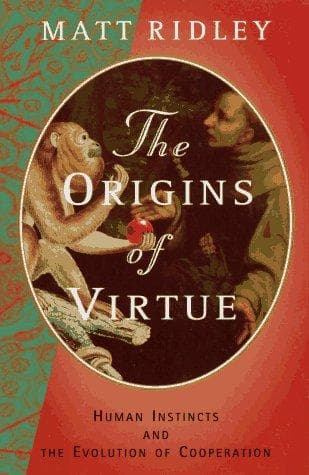
Book details and cover from Google Books.
Ready to read The origins of virtue?
Get your copy on Amazon, or listen to it on Audible. We earn a commission if you buy through these links.