
We earn a commission if you buy through these links. Learn more
The Origin of Species
Guide by the Books of the Day editors · Updated · How we write our guides
The foundational case for evolution by natural selection, built patiently from animal breeding, fossils, and geography, and still worth reading for how Darwin reasons through objections.
What Creators Say About The Origin of Species
2 creators reviewed The Origin of Species on YouTube between 2015 and 2026, with 226.6K views between them. Their opinions are their own; we picked these reviews, we didn't write them.
What It's About
Published in 1859, On the Origin of Species is Charles Darwin's sustained argument that living things have changed over vast spans of time, and that the main engine of that change is natural selection. Individuals with slightly advantageous variations tend to survive and leave more offspring, and over many generations those variations accumulate. Darwin does not open with the big claim. He builds it in stages, starting with domestic breeding, where people produce striking differences in animals and plants simply by choosing which ones reproduce.
Much of the book is a long defense against objections. Darwin takes on gaps in the fossil record, the difficulty of explaining elaborate organs, the way species are distributed across islands and continents, and the resemblances between the embryos of different animals. His tone is cautious and conversational. He often states a problem, admits its force, and then explains why his account still fits the evidence better than the alternatives. The pages are dense with examples drawn from birds, insects, plants, and barnacles, and you feel the weight of a naturalist who spent decades collecting and comparing specimens.
Reading it today is less like absorbing settled science and more like watching a scientist reason in public. The prose is clear for its era, but the detail is heavy and the argument is cumulative, so skipping sections weakens the whole case.
Read this if you…
- are curious how a major scientific argument is actually built, step by step
- want to understand the roots of modern evolutionary biology from its original source
- enjoy primary sources from the history of science and don't mind dense, deliberate prose
Skip it if you…
- want an up-to-date account that draws on genetics and molecular evidence
- need a short read, since the book is long and its examples pile up quickly
Key Ideas
- 1
Variation is the raw material
Darwin argues that no two individuals in a population are exactly alike, and that these differences are common, often small, and sometimes inherited. Everything else in his argument depends on this observation. He shows it through the variety that breeders produce in pigeons, cattle, and crops, which makes the idea feel concrete rather than abstract.
- 2
Natural selection as a filtering process
The struggle for existence is not a battle in the everyday sense. Darwin means that more offspring are born than can survive, so any variation that helps an individual cope with its conditions gives it a better chance of reproducing. Selection acts like a sieve, and over time the surviving forms differ from their ancestors in ways that suit their surroundings.
- 3
Common descent explains shared structure
Darwin proposes that related species descend from a common ancestor and diverge as they adapt to different places and ways of life. This accounts for why animals with very different lifestyles can still share similar bone arrangements, which he treats as evidence of ancestry rather than separate design.
- 4
Evidence from fossils, geography, and embryos
Rather than relying on a single proof, Darwin gathers independent lines of evidence. Fossils show succession of forms, the geographic spread of species follows patterns of migration and isolation, and embryos reveal resemblances that fade with maturity. The strength of the case lies in how these sources point in the same direction.
Limitations
Darwin had no workable theory of heredity. He relied on a blending model of inheritance that later research showed was wrong, and Mendel's work on discrete inheritance was unknown to him. The fossil record was far less complete than he hoped, and he knew it. The book focuses on animals and plants and mostly avoids applying its logic to humans. Its language is dated, and later writers used its ideas to justify social hierarchies that the argument itself does not support.
Questions Readers Ask
- Is On the Origin of Species still worth reading today?
- Yes, especially if you want to see the original reasoning rather than a summary. Much of the evidence has been refined or replaced, and genetics has transformed the picture, but the core logic of variation and selection still holds. Reading it shows why the idea was so persuasive and where Darwin's own uncertainties lay.
- How does it compare to a modern evolution textbook?
- A modern textbook is far more efficient and includes genetics, molecular evidence, and centuries of later research. The Origin is slower and more argumentative. It is better for understanding how the theory was defended and what questions it raised, while a textbook is better for learning the current science.
- Published
- 2002
- ISBN
- 9780393978674
- Difficulty
- intermediate
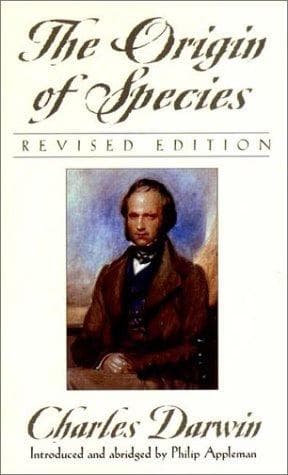
Book details and cover from Google Books.
Ready to read The Origin of Species?
Get your copy on Amazon, or listen to it on Audible. We earn a commission if you buy through these links.