
We earn a commission if you buy through these links. Learn more
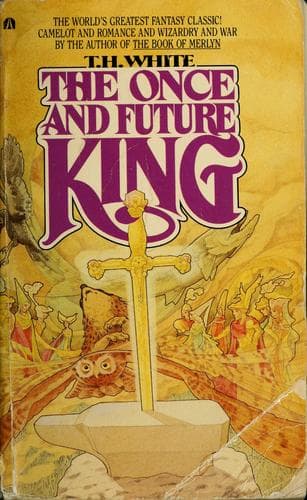
The Once and Future King
by T. H. White
Guide by the Books of the Day editors · Updated · How we write our guides
A sprawling, funny, and often melancholy retelling of the Arthur legend that treats boyhood learning, war, and the limits of good intentions with unusual candor.
What Creators Say About The Once and Future King
2 creators reviewed The Once and Future King on YouTube between 2020 and 2023, with 6.3K views between them. Their opinions are their own; we picked these reviews, we didn't write them.
What It's About
The Once and Future King is T. H. White's sprawling reworking of the Arthur legend, first published as a single book in 1958. It was assembled from earlier volumes White had written across the late 1930s and 1940s, plus a final section written for the collection. The story follows Arthur from a neglected boyhood, when he is known as Wart and schooled by the wizard Merlyn, toward the kingship at Camelot and the knights who gather around him.
White's voice is chatty and opinionated. He will break off mid-scene to talk to the reader, drop modern references into a medieval setting, and linger on hawking, hunting, and the details of castle life. Early on the tone is comic and playful, with much of the humor coming from Merlyn's unorthodox methods of teaching. As the sequence goes on, the mood darkens, and the ideals of the Round Table run into war, jealousy, and human frailty.
The reading experience is more like walking through a long, argumentative conversation than riding a straight plot. Expect to be charmed, then irritated, then moved, sometimes within a single chapter. Its power comes less from its events than from White's steady questioning of what kingship, loyalty, and fighting are actually for.
Read this if you…
- want a retelling of Arthurian legend that is funny in one chapter and grieving in the next
- enjoy discursive, opinionated narration more than a fast-moving plot
- are interested in the ethics of power and war, and in how stories about kingship hold up
Skip it if you…
- want a streamlined, action-driven Arthurian epic with a tight, linear plot
- find digressions on hunting, falconry, and wartime politics more tedious than enriching
Key Ideas
- 1
Learning to rule through unexpected lessons
Much of the first part is about Arthur's education, and White treats it as the foundation of kingship. Merlyn sends the boy into strange transformations, letting him learn about power, cooperation, and cruelty from the lives of other creatures. The idea that a ruler must understand how others live runs through the whole book.
- 2
Might, right, and the cost of war
The book keeps asking whether force can ever serve justice. White portrays the Round Table as a genuine attempt to replace feuding with law, then shows how that aim keeps being undone by violence. Written across the years around the Second World War, these scenes carry an edge that older retellings rarely have.
- 3
A medieval story told with modern irony
White keeps stepping outside the story to comment on politics, schooling, and human nature in the twentieth century. These asides can feel like jokes in one moment and sincere arguments in the next. Readers who expect a seamless historical romance may find the voice unsettling, but it is the book's most distinctive quality.
- 4
Love and loyalty that come undone
The emotional center is the friendships and rivalries among the knights and the royal court. Affection, pride, and jealousy push the ideal apart from within, and White is unusually willing to show how good people hurt each other. The emotional payoff comes from watching that slow erosion rather than from any single set piece.
Limitations
The book is uneven, and that is the first thing many readers notice. The opening section is light and funny, while the later parts are longer, heavier, and slower, especially the lengthy sections on Lancelot and the wider feud plotlines. White's digressions can feel self-indulgent, and his sense of humor sometimes reads as arch. Several female characters are thinly drawn, and some attitudes feel of their time. Readers wanting tight plotting or a fully modern psychological take on the legend will be frustrated.
Questions Readers Ask
- Is The Once and Future King a good first Arthurian book?
- It can be, especially if you start with the first section, which is lighter and more playful than what follows. It is less suitable for readers who want a straight retelling of the medieval sources, since White drew heavily on Malory but reshapes him freely. If you want something sparser and closer to the old texts, try Malory's own work alongside White.
- Is the Disney film The Sword in the Stone a substitute for the book?
- Not really. The 1963 Disney animated film takes its premise from the opening section of White's book and turns it into a light family comedy. It leaves out most of the darker material, the digressions, and the later parts of the story, so it works better as a companion than as a summary.
- Is it still worth reading today?
- Yes, especially for readers who like ethical questions inside a fantasy frame. Its arguments about war, power, and fairness still feel pointed, though some of its attitudes date from the mid-twentieth century. Read it for the voice and the moral argument rather than for modern realism, and it holds up well.
- Published
- 1939
- ISBN
- 9788497590914
- Difficulty
- intermediate
- Category
- Fiction
Book details and cover from Google Books.
Ready to read The Once and Future King?
Get your copy on Amazon, or listen to it on Audible. We earn a commission if you buy through these links.