
We earn a commission if you buy through these links. Learn more
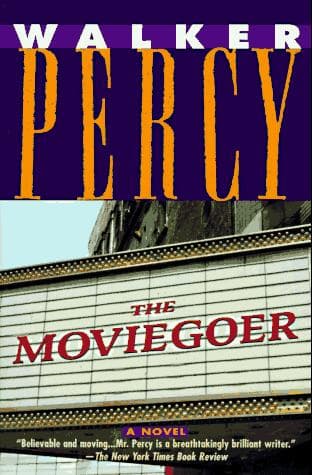
The Moviegoer
by Walker Percy
Guide by the Books of the Day editors · Updated · How we write our guides
A New Orleans stockbroker drifts through ordinary days with a moviegoer's eye, and Percy turns that drift into a sharp, funny inquiry into what it means to live well.
What Creators Say About The Moviegoer
2 creators reviewed The Moviegoer on YouTube between 2020 and 2023, with 26.5K views between them. Their opinions are their own; we picked these reviews, we didn't write them.
What It's About
The Moviegoer follows Binx Bolling, a young stockbroker in mid-century New Orleans who has returned from the Korean War and settled into a comfortable, mostly unremarkable life. He goes to the movies often, treating them as a kind of model for how ordinary life might be seen more vividly. What he is really after is what he calls everydayness, a state of simply being present to the world rather than waiting for something grand to happen. The novel is told in his first person, as a running account of his days, his work, his relatives, and his romantic entanglements.
Percy's style is conversational and often funny, moving between dry social comedy and sudden philosophical depth. Binx speaks directly to the reader, digresses, and offers theories about the people around him, so the book feels like overhearing a clever, restless mind thinking out loud. The plot moves slowly and is driven more by his moods and encounters than by suspense.
Reading it is less about events than about attention. It asks you to notice how you spend your time and whether your entertainments and routines are making you more alive. Its rewards come in quiet moments of clarity rather than in plot turns, so readers who want momentum may find the opening slow going.
Read this if you…
- enjoy novels of ideas where a conversational, comic voice carries the philosophy
- are curious about mid-century Southern life and the postwar American middle class
- want to think about how you spend your attention and whether your days feel meaningful
Skip it if you…
- need a plot-driven novel with clear stakes and a steady build of suspense
- expect a fast read; this one rewards patience and slow, reflective pacing
Key Ideas
- 1
Everydayness as a deliberate pursuit
Binx treats ordinary life as something that can be sought out and noticed, not merely endured. The book keeps asking what it would take to be fully present in a routine day, and it refuses to assume that excitement or drama is the only route to meaning.
- 2
Movies as a lens on real life
Binx loves films because they make familiar scenes feel charged and worth looking at. Percy uses this habit to examine the gap between watching life and living it, and whether we let other people's stories stand in for our own experience.
- 3
The malaise of comfortable affluence
Binx has money, a steady job, and social ease, yet he feels a persistent unease about his life. The novel explores how prosperity and convention can leave a person adrift, and how that restlessness can look like boredom from the outside.
- 4
Searching for meaning without a script
Percy's work is shaped by existentialist thought and by his Catholic faith, and the novel treats the search for meaning as open-ended. It offers no tidy answer, only a sharp portrait of a man trying to find his footing and taking his own confusion seriously.
Limitations
The novel is very much of its era. Its social world is white, male, and upper-middle-class, and some of its attitudes toward race, women, and class will feel dated or uncomfortable to modern readers. Binx's detachment can also be frustrating, and the philosophical musings sometimes run longer than the story can comfortably hold. Readers looking for a sustained critique of the social order it depicts may find it too tied to its protagonist's viewpoint. Its concerns with faith and existential searching are not for everyone, and the book does not offer a practical guide to finding meaning.
Questions Readers Ask
- Is The Moviegoer still worth reading today?
- Yes, especially if you are interested in questions about attention, meaning, and modern comfort. Its prose is still lively and its observations about everyday life hold up well. Some of its social attitudes reflect the 1950s, so read it with that context in mind.
- How does The Moviegoer compare to Sartre's Nausea or Camus's The Stranger?
- All three explore alienation and the search for meaning in modern life. Percy's novel is warmer and funnier than Nausea, and less bleak than The Stranger. If you enjoyed those, The Moviegoer offers a more conversational, American-set version of similar questions.
- Published
- 1961
- ISBN
- 9780375701962
- Difficulty
- intermediate
- Category
- Fiction
Book details and cover from Google Books.
Ready to read The Moviegoer?
Get your copy on Amazon, or listen to it on Audible. We earn a commission if you buy through these links.