
We earn a commission if you buy through these links. Learn more
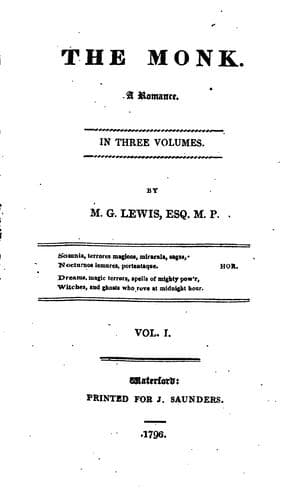
The Monk: A Romance. In Three Volumes. By M. G. Lewis, ..
A Gothic novel about a revered monk whose pride becomes his undoing, packed with ghosts, sorcery and scandal, and still a sharp, provocative attack on hypocrisy.
What It's About
The Monk is a 1796 Gothic novel by Matthew Gregory Lewis, written when he was still a young man and published to immediate notoriety. Its hero, Ambrosio, is a Capuchin friar in Madrid, admired across the city for his austere sermons and his reputation for holiness. The novel takes that reputation apart with gusto, tracking how his vanity and appetite lead him from small compromises toward something far worse.
Lewis layers several plots together: a love story between two young people that goes badly wrong, a convent intrigue, a family secret, and a run of supernatural interludes including a ghost story and a figure who has been wandering since antiquity. The chapters move quickly and often lurch from comedy to horror. Expect melodrama, overwrought speeches, and set pieces designed to shock, rather than the slow interior psychology of later novels.
Reading it is less like settling into a realist novel and more like riding a fast, bumpy carriage through a Gothic stage set. The pleasure lies in its energy, its audacity, and its sense that no institution or reputation is safe. Many readers find it funny in ways Lewis may not have intended, and still find some of its shocks effective, while others find the pacing and rhetoric exhausting.
Read this if you…
- enjoy early Gothic fiction and want to see where its tropes began
- like sharp satire of religious hypocrisy and don't mind melodrama
- are curious about the roots of horror and the Gothic villain-hero
Skip it if you…
- want psychological realism or subtle, slowly developed characters
- find melodrama, long speeches and convenient coincidence hard to enjoy
Key Ideas
- 1
Piety as a performance
Ambrosio's holiness is praised by the crowd, and he seems to believe it himself. The novel asks how much religious reputation is theatre, and how easily people accept a saint's word about his own virtue. Lewis's satire is aimed as much at the audience's credulity as at the friar.
- 2
Desire, pride, and the fall
Lewis treats appetite as a force that grows when it goes unchecked. Ambrosio's downfall is built from flattery, opportunity, and his refusal to see his own weakness. Notice how temptation is staged in steps rather than as a single lapse, which makes the moral argument feel more like a process than a verdict.
- 3
Gothic excess as a tool
The ghosts, sorcery, dungeons and ruins are more than decoration. They amplify the moral argument and let Lewis push scenes toward extremes. Some effects now feel campy, while others still land because the book commits to them completely.
- 4
Nested stories and a braided structure
The main plot is interrupted by embedded tales and parallel subplots, so the book feels like several novels woven together. Coincidences do a lot of the heavy lifting, which is part of its charm for some readers and a frustration for others.
Limitations
Lewis's prose is ornate and often stilted, and the plot leans heavily on coincidence and abrupt reversals. Its treatment of women is frequently misogynistic, and its portrayals of Spain, the Catholic Church and Jewish characters draw on stock prejudices of its era. Lewis also trimmed or altered material after the first edition drew public criticism for its sexual content, so the text readers encounter can vary by edition. The novel offers little balanced view of religion and only a sketchy portrait of its setting.
Questions Readers Ask
- Is The Monk still worth reading today?
- Yes, especially if you enjoy seeing where modern horror and Gothic fiction came from. The writing can feel dated and the plotting is loose, but the bold tone and sharp anti-clerical satire still feel surprisingly lively. Approach it as a wild, historically important experiment rather than a polished novel.
- How does The Monk compare to Frankenstein or Dracula?
- The Monk is rawer and more lurid than Frankenstein, which is more philosophically focused, and it is less controlled than Dracula, which builds suspense more carefully. If you liked Dracula's atmosphere, you may find Lewis's excess exhilarating, though his book is sprawling and less disciplined as a piece of construction.
- Is it a good choice for readers who don't usually like horror?
- It can be, because much of its effect comes from satire, melodrama and fast storytelling rather than from gore alone. Readers who dislike supernatural content or explicit material may still find it hard going, so it helps to sample a few chapters before committing.
- Published
- 1794
- ISBN
- 9788437613543
- Difficulty
- intermediate
- Category
- Fiction
Book details and cover from Google Books.
Ready to read The Monk: A Romance. In Three Volumes. By M. G. Lewis, ..?
Get your copy on Amazon, or listen to it on Audible. We earn a commission if you buy through these links.