
We earn a commission if you buy through these links. Learn more
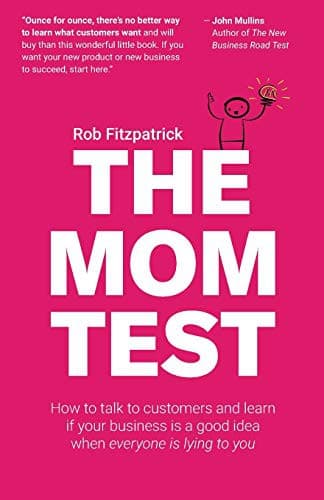
The mom test
Guide by the Books of the Day editors · Updated · How we write our guides
A short, practical guide to interviewing customers so you learn what is true about their problems instead of hearing what they think you want to hear.
What Creators Say About The mom test
2 creators reviewed The mom test on YouTube between 2020 and 2022, with 82.2K views between them. Their opinions are their own; we picked these reviews, we didn't write them.
What It's About
The Mom Test is a short guide to customer conversations for anyone building something new, whether a startup, a side project, or a feature inside an existing business. Its starting premise is that people, including your friends and family, will politely tell you your idea is great, and that those compliments tell you almost nothing about whether anyone will pay for it. The book's job is to teach you how to ask questions that produce information you can actually act on.
Fitzpatrick writes in a direct, conversational voice, full of worked examples of weak and improved questions. Much of the book works by contrast: a flawed opener, an explanation of why it fails, and a rewrite that gets closer to the truth. Reading it feels less like absorbing theory and more like watching someone correct your habits in real time. It is quick to get through, and many readers finish it with a mental checklist they can use before their next meeting.
The advice is aimed at early-stage discovery rather than polished marketing or sales scripts. It assumes you have a hypothesis to test and people to talk to, and it is most useful before you have written much code or committed much money. If you are looking for growth tactics, pricing models or fundraising advice, you will need other books.
Read this if you…
- are about to start a business, side project or product and want to test the idea before building it
- already manage people or products and need to learn how to talk to users without leading them
- want a short, concrete book you can finish in an afternoon and apply the next day
Skip it if you…
- want a broad book on startup strategy, fundraising or growth tactics
- are looking for detailed research methods or academic theory about interviewing
Key Ideas
- 1
Talk about their life, not your idea
Pitching your idea invites polite encouragement, because people are kind and eager to please. The book suggests steering conversations toward the other person's routines, frustrations and recent decisions. What they already do about a problem, and what it has cost them, is far more reliable evidence than how they react to a description of your solution.
- 2
Ask about specifics in the past
Questions about what someone would do, or whether they think something is a good idea, produce opinions and guesses. Fitzpatrick argues for asking about concrete events that already happened: when the problem last came up, what they did, and what it cost them. Specific stories are harder to fake and give you details you can build from.
- 3
Compliments and hypotheticals are bad data
The book names certain responses as fluff: compliments, vague enthusiasm, and promises to buy someday. These feel encouraging but do not predict behavior. Hypothetical questions invite made-up answers. The skill is recognizing when you are collecting noise, then pushing for something that costs the other person time, money or reputation.
- 4
Commitments and next steps reveal real interest
Real interest shows up as action: an introduction to someone else, time spent on a follow-up, a payment, or a small step that is hard to undo. The book encourages you to ask for these commitments and to notice when people decline to make them. A polite no is useful information, and often more useful than an enthusiastic yes.
Limitations
The book is deliberately narrow. It focuses on the interview stage and says little about analyzing data at scale, marketing channels, pricing, or building a sales function. Some readers find the examples repetitive, and the tone can feel blunt if you are sensitive to criticism. Its advice is also general: it does not replace domain knowledge, and it can be misapplied by people who treat every interview as a validation exercise rather than a learning one. Read it as a method, not a complete playbook.
Questions Readers Ask
- Is The Mom Test still relevant if I am not building a startup?
- Mostly, yes. The principles apply to any situation where you need honest feedback from users, including internal product teams, consultants and nonprofit program design. The examples lean toward software and early-stage companies, so you may need to translate them, but the core skill of asking about past behavior rather than opinions transfers easily.
- How does it compare to The Lean Startup?
- The Lean Startup by Eric Ries covers the broader process of building, measuring and learning across a company. The Mom Test zooms in on one skill within that process: the customer conversation. Many people read both, using Ries for the framework and Fitzpatrick for the interview technique. The Mom Test is far shorter and more immediately practical.
- Published
- 2014
- ISBN
- 9781492180746
- Difficulty
- beginner
- Category
- Business
Book details and cover from Google Books.
Ready to read The mom test?
Get your copy on Amazon, or listen to it on Audible. We earn a commission if you buy through these links.