
We earn a commission if you buy through these links. Learn more
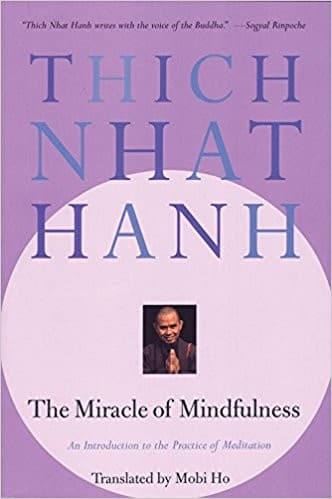
The Miracle of Mindfulness
Guide by the Books of the Day editors · Updated · How we write our guides
A short, practical guide to paying attention to ordinary moments, from breathing to washing dishes, by a Zen teacher who wrote for readers with no prior practice.
What Creators Say About The Miracle of Mindfulness
2 creators reviewed The Miracle of Mindfulness on YouTube between 2021 and 2022, with 9.9K views between them. Their opinions are their own; we picked these reviews, we didn't write them.
What It's About
The Miracle of Mindfulness is a small book built from talks Thích Nhất Hạnh gave on mindfulness, a Buddhist idea of attending fully to what is happening in the present moment. It is less a manual of techniques than an invitation to notice how rarely most of us are where we are. Its core instructions are simple: follow your breath, walk with awareness, and treat everyday chores as the practice itself.
The tone is warm, unhurried and plain. Nhất Hạnh writes like a patient teacher speaking to beginners, often using concrete domestic examples rather than doctrine. Readers expecting dense scripture or a scientific case for meditation will find something lighter. The Buddhist framework runs through the book, but it is offered as a working tool rather than a belief system you must adopt.
Reading it feels closer to sitting with a teacher than studying a text. Because it is short, it can be finished in an evening, but its suggestions are meant to be tried slowly, over weeks, in ordinary life. The experience rewards small, repeated practice more than quick comprehension.
Read this if you…
- want a gentle, practical starting point for meditation and have never tried it
- feel scattered and would rather adopt small daily habits than commit to a long program
- are curious about Buddhist ideas but prefer them presented plainly and without heavy doctrine
Skip it if you…
- want scientific research or clinical evidence for mindfulness, since this book rests on its tradition and personal experience
- already maintain a serious meditation practice and are looking for advanced instruction in concentration or deeper Buddhist training
Key Ideas
- 1
Mindfulness as simple, present-moment attention
Mindfulness here means being aware of what you are doing while you do it, rather than thinking about it or rehearsing the next task. The book argues that much of our restlessness comes from living in the past or future, and that paying steady attention to the present is itself the practice. It is a skill anyone can begin without special training.
- 2
The breath as an anchor
Returning attention to the in-breath and out-breath gives a wandering mind something concrete to hold. Nhất Hạnh presents this less as a technique to master and more as a repeatable way to come back to the present whenever you notice you have drifted. The simplicity is deliberate, and it is the part many readers return to most.
- 3
Walking and dishwashing as practice
A central point is that meditation does not belong only on a cushion. Walking and everyday housework can be done with the same full attention, which turns routine moments into occasions for calm rather than things to rush through. This idea makes the book useful to people who find formal sitting hard to keep up.
- 4
Inner peace as the starting point
The book connects personal mindfulness to a wider concern for peace, reflecting the author's long engagement with social and political suffering. Its argument is that calm and compassion in the individual are the foundation for better relationships and, eventually, a more peaceful world. Readers looking for explicit social analysis will find this only briefly sketched.
Limitations
The book is very short, and some readers find its explanations repetitive or thin if they expect structured guidance over several weeks. It was written in a particular time and cultural context, and its examples and language can feel dated. Its Buddhist framing may put off readers who want a purely secular approach, and it does not engage with the modern research on meditation that many people now look for. Those who want a fuller, step-by-step program will need to look further.
Questions Readers Ask
- Is The Miracle of Mindfulness still useful today?
- Yes. The core instructions on breathing and walking do not depend on their era, and the ideas translate well to modern life. The language is old-fashioned in places and the examples reflect their time, but most readers find the book's brevity and clarity an advantage in a distracted age.
- How does it compare to Jon Kabat-Zinn's Wherever You Go, There You Are?
- Kabat-Zinn's book is more secular and more structured, drawing on his stress-reduction work and offering a wider range of practices. Nhất Hạnh's book is more explicitly Buddhist, shorter and more poetic. If you want a framework for daily practice, Kabat-Zinn may suit you better; if you want a quiet, simple introduction, this one fits well.
- Do I need to be Buddhist to get something from it?
- No. Nhất Hạnh writes for general readers, and the practices are open to anyone. The Buddhist background explains where the ideas come from, and curious readers will find it a good entry point to the tradition. You can also treat the exercises simply as tools for paying attention.
- Published
- 1987
- ISBN
- 9780807012017
- Difficulty
- beginner
- Category
- Buddhist meditations
Book details and cover from Google Books.
Ready to read The Miracle of Mindfulness?
Get your copy on Amazon, or listen to it on Audible. We earn a commission if you buy through these links.