
We earn a commission if you buy through these links. Learn more
The mind is flat
by Nick Chater
Nick Chater's short, provocative case that the mind has no hidden depths, only thinking improvised in the moment, will change how you see your own certainties and choices.
What It's About
The Mind Is Flat, published in 2018, is a short argument about what the mind actually is. Nick Chater, a behavioural scientist, takes aim at a picture most of us share: that beneath everyday thinking lies a deep, stable self full of fixed beliefs, buried desires and hidden motives, waiting to be uncovered by therapy, introspection or a clever experiment. His claim is that this picture is mistaken. What we experience as our inner life is largely improvised on the spot, assembled from shallow processes in response to whatever is in front of us.
The style is brisk and conversational rather than academic. Chater builds his case from research in perception, decision-making, memory and social psychology, showing repeatedly how choices, opinions and even moral judgements shift with context and framing. He tends to let an example do the work before stating the principle behind it. The book is short enough to read in an evening or two and is written for a general audience.
Reading it feels less like collecting facts and more like watching a familiar assumption come apart. Some readers will find this liberating; others will find it unsettling, because it recasts the self as a performance rather than a possession. It rewards slow thinking about how sure you really are of what you think.
Read this if you…
- are curious about how reliable your own introspection really is
- enjoy short, argument-driven books that challenge common sense
- work in policy, marketing, education or any field that depends on how people decide
Skip it if you…
- want a practical self-help guide with step-by-step methods
- are looking for a detailed survey of neuroscience or the brain's architecture
Key Ideas
- 1
No hidden self waiting underneath
Chater challenges the idea of a deep inner self that holds our true beliefs and desires. In his view, there is no secret reservoir of stable attitudes below conscious life. When you look for your real opinion, you are more likely to construct one than to find one already sitting there, and the book shows why that matters for how we judge ourselves and others.
- 2
Thoughts are improvised, not retrieved
The mind, on this account, works by generating answers on demand rather than looking them up in a fixed store. Memory, reasoning and feeling are all reconstructed as needed. This reframing explains why the same person can give different answers to the same question at different times, and why confident recall is not proof of accuracy.
- 3
Preferences are built in the moment of choice
Chater argues that what we want is often made up as we choose, shaped by the options on the table, the way they are presented and the surrounding context. Rather than consulting a fixed ranking of tastes, we assemble a preference when asked. This has obvious consequences for advertising, policy and the idea that people always know their own minds.
- 4
Why the illusion of depth persists
If the mind is flat, the sense of inner richness needs explaining. Chater considers why we feel we have hidden depths, drawing on our need for a coherent story about ourselves and the way our conscious narrative fills gaps after the fact. The explanation of this illusion is one of the most useful parts of the book for readers who want to understand their own habits of self-description.
Limitations
Critics argue that Chater leans heavily on a selection of experiments that fit his case, and that some of the evidence for on-the-fly construction is contested. Memory and stable dispositions do seem to matter in ways the book can underplay. It is also more concerned with overturning an assumption than with offering a full theory of mind, so readers who want a complete account of consciousness or cognition will need to look elsewhere. Some passages are dense for a general audience.
Questions Readers Ask
- Is The Mind Is Flat still relevant today?
- Yes. Its core questions about introspection, preference and the reliability of the self have only become more pressing as researchers study decision-making and as tools for shaping choices have spread. The book is short, so it is easy to revisit its central argument against newer work and decide for yourself where it holds up.
- How does it compare with Thinking, Fast and Slow?
- Both draw on behavioural research to question how we decide. Kahneman's book is broader and more of a tour of cognitive biases. Chater is narrower and more philosophical, focusing on whether there is a deep inner mind at all. Readers who liked Kahneman's examples often find Chater's argument the more unsettling of the two.
- Published
- 2018
- ISBN
- 9780241208441
- Difficulty
- intermediate
- Category
- Psychology
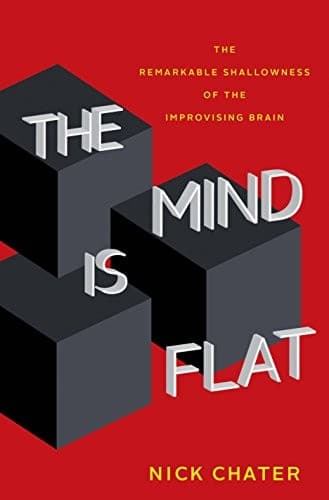
Book details and cover from Google Books.
Ready to read The mind is flat?
Get your copy on Amazon, or listen to it on Audible. We earn a commission if you buy through these links.