
We earn a commission if you buy through these links. Learn more
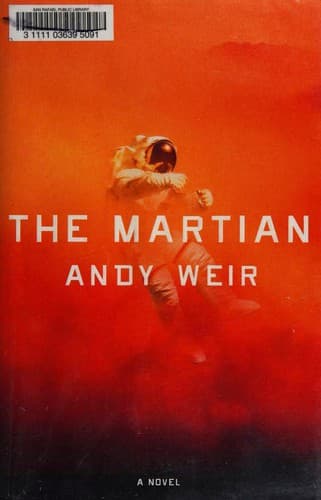
The Martian
by Andy Weir
On screen: The Martian (film, 2015)
A stranded astronaut must improvise survival on Mars with whatever he can build, grow, or repair, and the book makes that problem-solving thrilling, funny, and easy to follow.
What It's About
The Martian opens with Mark Watney, an astronaut on a crewed mission to Mars who is left behind when a dust storm forces his crew to evacuate, and he is presumed dead. He wakes up alone with limited supplies, no way to contact Earth yet, and a habitat built for a month-long stay. The premise is simple, but the book is about the practical problem of staying alive.
Much of the book is written as Watney's log entries, and the voice is the main pleasure. He is wry, impatient, and funny even when things go badly, so the tone stays light despite the danger. The storytelling alternates between his daily problem-solving and cuts to mission control on Earth, where engineers and officials argue over whether and how to reach him. Weir gives each technical obstacle a clear, step-by-step logic, so you follow the reasoning rather than just the outcome.
The reading experience is brisk and page-turning, closer to a problem-solving thriller than a literary novel. Characters are sketched rather than deeply explored, and the emotional weight comes mostly from Watney's isolation and the scale of the odds. If you enjoy watching competent people work a hard problem under pressure, the book delivers that consistently from start to finish.
Read this if you…
- love hard science fiction and enjoy technical problem-solving
- want a fast, funny survival story with a likable narrator
- are looking for a book you can finish in a few sittings
Skip it if you…
- want character-driven literary fiction with deep interiority
- find constant jokes and log-style narration tiring over a whole novel
Key Ideas
- 1
Problem-solving as the main plot
Much of the story is built around a single technical question: how to make water, grow food, or stretch air supply with what is on hand. Weir shows each attempt, the reasoning behind it, and the failures along the way. The suspense comes from whether the fix works, which keeps the story moving even when little else is happening.
- 2
A voice that carries the emotional load
Watney's log is sarcastic, practical, and often funny, and that humor is how he copes with isolation. The book relies on it heavily, so readers who tire of the jokes may find the book wearing. The contrast between his bravado and the fear underneath gives the story its feeling.
- 3
Coordination and pressure beyond the planet
The story also tracks the people trying to bring him home: staff on Earth and his crewmates in space. Weir shows how a rescue becomes a coordination problem with politics, public pressure, and risk attached. These scenes give the book its sense of scale and show that rescue depends on many people making sound calls together.
- 4
Science presented as a human activity
Weir cares about getting the physics and chemistry right, but he presents them through a character who improvises rather than lecturing. Readers who like hard science will enjoy the accuracy, while those who do not will find the detail easy to skim without losing the plot.
Limitations
Criticisms usually focus on thin characterization outside Watney and on prose that is functional rather than graceful. Some readers find the science dense in places, and the humor can feel repetitive to anyone who does not click with the voice. The book also rests on a fairly optimistic arc, and its technology and assumptions reflect the era in which it was written, though the core survival problems remain sound.
Questions Readers Ask
- Do I need a science background to enjoy The Martian?
- No. Weir explains the relevant math and chemistry in plain language through Watney's own reasoning, and the problems are concrete enough to follow without prior knowledge. Some passages are technical, and a reader who skims them loses little of the plot.
- How does The Martian compare to Project Hail Mary?
- Both are Weir novels built around a lone scientist solving problems with science. Project Hail Mary is broader in scope and has a larger emotional core, while The Martian is tighter and more focused on survival logistics. If you liked one, you will likely enjoy the other.
- Is The Martian still worth reading today?
- Yes. The survival problems are presented clearly, and the pacing holds up well. Some technical details and assumptions reflect when the book was written, but that matters much less than the storytelling and the sense of momentum.
- Published
- 2011
- ISBN
- 9789045210841
- Difficulty
- beginner
- Category
- Fiction
Book details and cover from Google Books.
Ready to read The Martian?
Get your copy on Amazon, or listen to it on Audible. We earn a commission if you buy through these links.