
We earn a commission if you buy through these links. Learn more
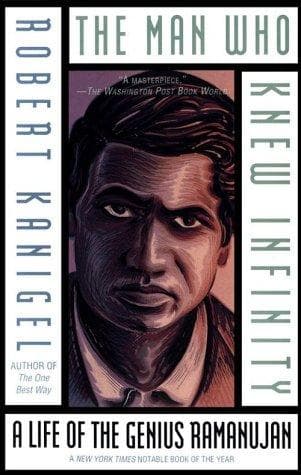
The Man Who Knew Infinity
Kanigel's biography follows Srinivasa Ramanujan from a Madras clerk's desk to Cambridge, tracing the clash of intuition and formal proof and the personal cost of his brief, brilliant career.
What It's About
The Man Who Knew Infinity is a biography of Srinivasa Ramanujan, the self-taught Indian mathematician whose letters to G.H. Hardy at Cambridge in 1913 started one of the most unusual collaborations in modern mathematics. Robert Kanigel, a science writer rather than a mathematician, builds the story from Ramanujan's early years in southern India, his unlikely working life as a clerk, the correspondence that reached England, and the years of strain that followed his move there during the First World War.
The book's strength is its narrative and its human detail. Kanigel writes in a clear, steady prose that keeps the reader oriented in three worlds at once: colonial Madras, the insular academic culture of Cambridge, and Ramanujan's private inner life, which included deep religious devotion and a conviction that his results came to him in visions. He explains the mathematics at a level a general reader can follow, focusing on what the ideas meant to the people working on them rather than on the proofs themselves.
Reading it feels like following a sad, absorbing true story with a clear arc. It is more a portrait of a person and a relationship than a guide to his theorems, and it leaves you with a sharp sense of how much talent depended on chance, sponsorship, and the willingness of one stubborn Englishman to take a letter seriously.
Read this if you…
- you enjoy biographies that read like well-told narrative history rather than academic studies
- you are curious about how a brilliant outsider got through the British academic system
- you want a human story about mathematics without needing to follow the equations
Skip it if you…
- you want a detailed explanation of Ramanujan's mathematics or his notebooks
- you prefer a strictly chronological, source-by-source scholarly account
Key Ideas
- 1
Intuition set against formal training
Ramanujan arrived at results with little formal schooling and often could not show how he reached them. Kanigel uses this gap to examine what counts as mathematical knowledge, and how Hardy, trained in rigorous proof, tried to make Ramanujan's findings respectable without flattening what made them remarkable.
- 2
Hardy and Ramanujan as an unlikely partnership
The relationship between the rigid, skeptical Englishman and the devout, unconventional Indian is the emotional core of the book. Kanigel shows how each man changed the other's thinking, and how their collaboration was shaped by the assumptions of the period about race, class, and who belonged in the academy.
- 3
Life in England during wartime
Ramanujan's years at Trinity College unfolded during the First World War, far from home and in a culture that often treated him as a curiosity. Kanigel describes the isolation, the diet and religious constraints he struggled with, and the health problems that came to dominate his last years.
- 4
Genius, recognition, and what was lost
The book asks what a short life of extraordinary output means and how recognition depends on who is willing to look. Kanigel handles Ramanujan's early death without sentimentality, presenting it as the end of a career that was still producing ideas that mathematicians would work on for decades.
Limitations
Kanigel is not a mathematician, so the technical material is simplified and some readers will want more depth on the actual results. The book was published in 1991 and predates later scholarship on Ramanujan's notebooks and manuscripts, so newer research on his work is not reflected. Its framing of colonial India and of Ramanujan's inner life, including his spiritual explanations of his results, can read as dated or selective to some modern readers, and a few critics have felt Hardy's perspective dominates the story.
Questions Readers Ask
- Do I need a background in mathematics to enjoy this book?
- No. Kanigel explains the general nature of Ramanujan's work and the disagreements around it without asking you to follow proofs. Some familiarity with the idea of a theorem helps, but the book is written for general readers and focuses on the people, the letters, and the circumstances rather than the formulas.
- How does it compare with the film based on the same story?
- The book gives far more context than the 2015 film of the same name, which is based on it. You get the full sweep of Ramanujan's Indian years, his correspondence, the wartime setting, and the difficult professional relationships in Cambridge. Readers who enjoyed the film usually find the book adds depth and nuance.
- Published
- 1991
- ISBN
- 9781433210341
- Difficulty
- intermediate
- Category
- Biographies
Book details and cover from Google Books.
Ready to read The Man Who Knew Infinity?
Get your copy on Amazon, or listen to it on Audible. We earn a commission if you buy through these links.