
We earn a commission if you buy through these links. Learn more
The Making of the Fittest
Guide by the Books of the Day editors · Updated · How we write our guides
Carroll shows how DNA evidence can pin visible evolutionary change to specific genetic switches, making a complex field readable for curious non-specialists.
What Creators Say About The Making of the Fittest
2 creators reviewed The Making of the Fittest on YouTube between 2023 and 2024, with 234 views between them. Their opinions are their own; we picked these reviews, we didn't write them.
What It's About
The Making of the Fittest is Sean B. Carroll's account of how modern genetics has turned evolution into something close to a forensic science. Carroll, a developmental biologist, argues that the genome now keeps a readable record of how organisms change over time. He builds the book around case studies in which researchers traced an obvious difference between populations or species back to particular changes in DNA, and then tested whether those changes really caused the difference.
The experience is part science narrative and part behind-the-scenes look at how research is done. You will hear about fieldwork, breeding experiments, and the comparison of genes across species, and Carroll explains the basic genetics you need along the way. The tone is enthusiastic but disciplined. He is more interested in how scientists weigh evidence than in grand declarations, so the book rewards patient reading and a willingness to follow an argument step by step.
It was published in 2006, and the field has moved fast since then, with sequencing now far cheaper and many specific findings refined. The core argument, that much evolutionary change happens in how genes are switched on and off rather than in the genes themselves, still holds up well and remains useful background.
Read this if you…
- want to understand how genetics explains real evolutionary change, not just the theory
- enjoy science writing that walks through experiments and reasoning step by step
- are curious about evo-devo and why similar genes appear in very different animals
Skip it if you…
- want a broad survey of all of evolution, including human origins and fossil history
- need a light read and find detailed genetic explanations tiring
Key Ideas
- 1
Evolution leaves a readable genetic trail
Carroll's central claim is that differences between organisms are written in their DNA, so scientists can work backward from a trait to the genetic changes that produced it. He treats this as a kind of detective work, where each case needs its own evidence, controls, and alternative explanations before a conclusion is credible.
- 2
Change often happens in switches, not parts
A recurring theme is that new forms usually arise from changes in regulatory DNA, the sequences that control when and where genes act, rather than from rewritten protein-coding genes. This helps explain how major differences can emerge from relatively small genetic edits, and why the same basic genes appear across very different animals.
- 3
Case studies do the heavy lifting
Rather than arguing in the abstract, Carroll anchors his points in specific organisms and traits that researchers have studied closely. The examples make the abstract ideas concrete, and they show how a hypothesis about a trait can be tested in the lab and in the wild.
- 4
Science as an evidence-driven process
Much of the book's value lies in its portrayal of how knowledge is built: forming hypotheses, designing experiments, and revising conclusions when the data push back. Readers who care about how scientific claims are justified will find this as rewarding as the biology itself.
Limitations
The book is selective, built around a handful of case studies rather than a comprehensive account of evolution, so some areas get little attention. Because it was written in 2006, specific findings and sequencing methods have been updated, and readers should check recent work before relying on particular details. Some reviewers find the middle sections dense if they lack a background in genetics. The emphasis on regulatory DNA is persuasive but is presented with a strong point of view that other biologists may weigh differently.
Questions Readers Ask
- Do I need a background in biology to read it?
- No, but it helps. Carroll explains the core genetics as he goes, so a patient general reader can follow the arguments. Readers with some high school biology will find the material easier to place, and the case studies are engaging enough that the technical passages feel worthwhile rather than like homework.
- How does it compare to The Greatest Show on Earth by Richard Dawkins?
- Dawkins makes a broad, persuasive case for evolution as a whole, drawing on many fields. Carroll is narrower and more hands-on, focusing on how genetic evidence reveals the mechanics of specific changes. If you want the big picture first, Dawkins is the better start. If you want to see how scientists actually test ideas with DNA, Carroll fits better.
- Published
- 2006
- ISBN
- 9781400103157
- Difficulty
- intermediate
- Category
- Science
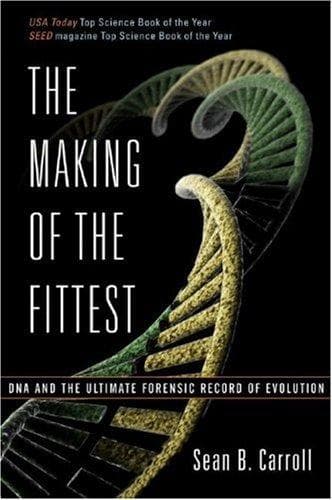
Book details and cover from Google Books.
Ready to read The Making of the Fittest?
Get your copy on Amazon, or listen to it on Audible. We earn a commission if you buy through these links.