
We earn a commission if you buy through these links. Learn more
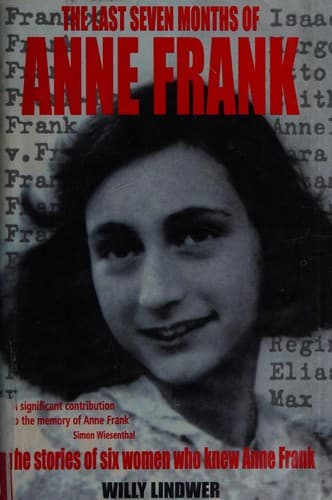
The last seven months of Anne Frank
Guide by the Books of the Day editors · Updated · How we write our guides
A short, unsparing oral history built from the memories of women who were with Anne Frank in Bergen-Belsen, showing the last months of her life from people who saw them firsthand.
What Creators Say About The last seven months of Anne Frank
1 creator reviewed The last seven months of Anne Frank on YouTube in 2026, with 58 views between them. Their opinions are their own; we picked these reviews, we didn't write them.
What It's About
Willy Lindwer, a Dutch filmmaker and writer, built this book from interviews with women who were imprisoned alongside Anne Frank in the final months of her life. After she and her sister were moved from Auschwitz to Bergen-Belsen in late 1944, Anne spent the winter there in conditions of hunger, cold, and disease. The book gathers what these survivors remember about her, about the camp, and about the people around them.
The approach is plain. Each woman speaks largely in her own voice, and Lindwer's framing is light, so the reader hears recollections rather than a narrator's argument. The result feels closer to listening to witnesses across a table than to reading history. Memories sometimes disagree or fade, and the book leaves those gaps visible instead of smoothing them over, which is part of why it reads as honest.
Reading it is an emotionally heavy experience, and it is brief enough to finish in a few sittings. It works best as a companion to Anne Frank's own diary. The diary shows her inner life; this book shows how she appeared to others, and what the world she lived in was like at its worst.
Read this if you…
- want to understand Anne Frank's final months through the voices of people who were with her
- are interested in oral history and how survivors' testimony is gathered and presented
- have already read the diary and want to see how she appeared to those around her
Skip it if you…
- want a continuous, chronological narrative with a single authorial voice throughout
- are looking for a light read, since the subject is harrowing and the material is repetitive in places
Key Ideas
- 1
Testimony as a form of historical evidence
The book rests on the idea that ordinary witnesses can preserve what official records miss. Lindwer lets his interviewees describe small details of daily life, such as how people shared food, slept, and kept clean, that documents rarely capture. Reading it, you see how much history survives only in personal memory.
- 2
Anne seen from the outside
Because the diary is written in Anne's own voice, it is easy to forget how others experienced her. These accounts offer a different portrait: a young person among strangers, under strain, whose behavior and fears looked different to the people beside her. The contrast gives the diary's intimacy more weight.
- 3
The conditions of Bergen-Belsen in its final stretch
The book describes the disorder, sickness, and scarcity of the camp in its last months. These details make clear that survival depended heavily on chance, relationships, and physical endurance. The picture is grim but specific, which keeps it from becoming abstract suffering.
- 4
Memory's limits and the cost of remembering
The survivors interviewed are often uncertain, and some are reluctant or pained when recalling events. The book shows how trauma shapes what people remember and how they talk about it decades later. Readers will notice the gaps and contradictions, and they are a useful reminder of how fragile testimony can be.
Limitations
The book is built from a limited set of interviews, so it covers only a narrow window of Anne's life and a small circle of witnesses. Memories from decades later can be incomplete or shaped by time, and the book does not try to resolve every contradiction. Some readers may want more historical context about the camp system or the wider war than the book provides. Because it is assembled from interviews, it reads more as a collection of testimony than as a full biography.
Questions Readers Ask
- Should I read this before or after The Diary of a Young Girl?
- Most readers find it works better after the diary. The diary gives Anne's own voice and inner life, and this book then shows the camp and the people around her in her final months. Read cold, the book can feel fragmentary because it assumes some familiarity with who Anne was.
- Is this book suitable for teenagers?
- Many schools and families use it with older teens, usually alongside the diary. It is not graphic in a sensational way, but it describes starvation, disease, and death in plain terms, so adults may want to read it first and talk through the content with younger readers.
- Published
- 1999
- ISBN
- 9780333779651
- Difficulty
- beginner
- Category
- Biographies
Book details and cover from Google Books.
Ready to read The last seven months of Anne Frank?
Get your copy on Amazon, or listen to it on Audible. We earn a commission if you buy through these links.