
We earn a commission if you buy through these links. Learn more
The Knowledge
Guide by the Books of the Day editors · Updated · How we write our guides
A friendly thought experiment on what it would take to rebuild modern technology after collapse, and a good way to see how much of everyday life rests on earlier discoveries.
What Creators Say About The Knowledge
2 creators reviewed The Knowledge on YouTube between 2014 and 2025, with 3.8K views between them. Their opinions are their own; we picked these reviews, we didn't write them.
What It's About
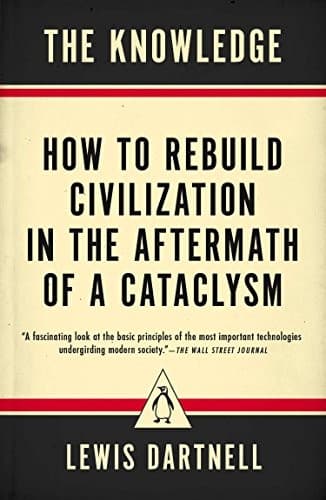
The Knowledge is a popular science book built around a thought experiment: if civilization collapsed and you were one of the survivors, with libraries and power grids gone, what would you need to know to get back to a working technological world? Rather than writing a survival manual, Lewis Dartnell works through the foundations of modern life, including fire, farming, metalworking, glass and chemicals, sanitation, medicine, and finding your way by the stars. The central question gives the book a sense of purpose, so it reads like a series of practical problems that people had to solve once before.
The writing is friendly and wide-ranging. Dartnell moves easily between history, chemistry, and physics, often showing how each discovery depended on earlier ones and on easily reached resources such as surface ores and fuels. Explanations of basic science are kept plain, and the tone is playful without becoming glib.
The experience is closer to a guided tour of things most of us take for granted than to a how-to guide. You finish with a clearer sense of how interdependent modern technology is, and of which facts would be hardest to rebuild from memory alone. Readers who want detailed, step-by-step instructions will find the book thinner than they hoped.
Read this if you…
- want to understand how interconnected modern technology really is
- enjoy big-picture history of science told with curiosity and humor
- like thinking through hypothetical problems and how you would solve them
Skip it if you…
- want a practical survival or step-by-step manual
- expect detailed technical instructions for building specific tools or chemicals
Key Ideas
- 1
Hidden dependencies behind everyday technology
The thought experiment makes visible how many layers sit beneath simple objects. A single tool or medicine rests on mining, chemistry, transport, and agriculture, all of which would need to be restarted. Dartnell's main lesson is that modern comfort is a chain of prerequisites, and that losing one link can stall the whole chain.
- 2
Principles matter more than specific recipes
Dartnell focuses less on exact procedures and more on the underlying concepts that make procedures work. Knowing why a process succeeds, such as how heat changes materials or how observation tests an idea, is more useful to a rebuilding society than remembering a single formula. This emphasis turns the book into a case for understanding how things work.
- 3
Easy resources shaped how civilization advanced
Early progress depended on resources that were easy to reach, such as surface deposits and readily available fuel. Once those were used up, later advances became harder and slower. The idea helps explain why a rebuilt civilization would face a much steeper climb than the original one did.
- 4
The scientific method as a shortcut
Dartnell argues that a systematic way of testing ideas can save generations of trial and error. A rebuilding society that understood observation, measurement, and repetition could reach reliable results faster. The book presents the method as a tool for recovering knowledge rather than as an abstract ideal.
- 5
Agriculture as the foundation of civilization
Reliable food production is what frees people to specialize, build settlements, and pursue other crafts. Dartnell treats farming as the first problem any rebuilding society must solve, since everything else depends on it. This framing gives the book's wider chapters a logical order.
Limitations
The book is speculative by design, so its scenarios are illustrative rather than tested. Its practical detail is uneven: concepts are clear, but specific techniques are often sketched rather than explained in depth. Some readers find the historical digressions enjoyable, while others feel they dilute the central question. Parts of the science may also feel general to readers who already know the basics of chemistry or engineering.
Questions Readers Ask
- Is The Knowledge useful as a survival guide?
- Not really. It is better understood as an exploration of the principles behind modern technology than as a practical manual. It can give you a sense of what would be needed to rebuild, but it does not give the step-by-step detail a survival guide would. Readers looking for hands-on instructions should look at dedicated preparedness books.
- Who is this book best suited to?
- It suits general readers curious about science, history, and how society works. You do not need a technical background, because the explanations are kept accessible. It is a good pick for book clubs or for anyone who enjoys big questions framed around a simple premise.
- Published
- 2014
- ISBN
- 9781594205231
- Difficulty
- beginner
- Category
- Tech
Book details and cover from Google Books.
Ready to read The Knowledge?
Get your copy on Amazon, or listen to it on Audible. We earn a commission if you buy through these links.