
We earn a commission if you buy through these links. Learn more
The Innovators
by Walter Isaacson, Francisco José Ramos Mena
Guide by the Books of the Day editors · Updated · How we write our guides
A wide-angle history of computing and the internet that shows how teams of engineers, scientists and visionaries built the digital world, ideal for readers who want the big picture first.
What It's About
The Innovators traces the history of computing and the internet through the people who built them, starting with Ada Lovelace and Charles Babbage in the nineteenth century and running through the transistor, the personal computer, open-source software, the web and search engines. Isaacson, known for his biographies of Benjamin Franklin, Albert Einstein and Steve Jobs, moves roughly chronologically, following each invention to the next generation of people who improved on it. This page covers the English edition, which is credited to Isaacson alone, so the second name in the listing should not be expected on the book itself.
His central argument is that the digital age was built less by solitary geniuses than by teams, partnerships and networks of people who shared ideas openly, often across companies, universities and government labs. Readers who expect one hero per breakthrough will find a long chain of contributions instead, with famous names sitting beside engineers most people have never heard of. The writing is accessible and anecdotal, full of personality and rivalry, and it reads more like a sweeping group portrait than a technical manual.
The experience is that of a guided tour. Each section gives enough context to understand why an idea mattered and how it connected to what came before, then moves briskly on. You will come away with a clear sense of how the pieces fit together, though not with the depth needed to build anything yourself. It rewards patience with long chapters and dense cast lists, and it works best as a first map of the territory.
Read this if you…
- want a single-volume overview of how computing and the internet developed
- are curious about how teams and institutions shaped technology, not just famous founders
- prefer accessible storytelling with plenty of characters over dense technical explanation
Skip it if you…
- want a deep technical understanding of how processors, networks or software actually work
- are looking for a critical book on the social or economic harms of modern tech platforms
Key Ideas
- 1
Innovation as a team sport
Isaacson's core claim is that breakthroughs usually came from groups that mixed visionaries, engineers and managers, with ideas passed between them. Lone inventors appear, but the book keeps returning to collaboration as the engine that turned clever concepts into working systems used by millions.
- 2
Visionaries need engineers to succeed
The book repeatedly shows the gap between imagining a machine and making it work. Babbage's ambitious designs stalled where practical builders were missing, while later advances such as the transistor and integrated circuit depended on patient, unglamorous engineering. Ideas alone rarely changed the world without people who could implement them.
- 3
Public funding as a catalyst
Government money, especially defense-related research and university grants, seeded much of the early networking and computing work. The story of how that public investment fed private companies and later the commercial internet helps explain why the digital economy looks the way it does, and it challenges the idea that markets alone drove the change.
- 4
The open-sharing ethic
Many of the key tools, from internet protocols to Linux and collaborative projects like Wikipedia, grew from people freely sharing code and knowledge. Isaacson traces this hacker-influenced culture and shows how it competed with, and sometimes shaped, commercial software and proprietary business models.
- 5
Startup culture and its origins
Through the story of semiconductor firms in the Bay Area and their many spinoffs, the book explains how a dense cluster of talent, capital and shared know-how produced a repeatable pattern of founding companies. It offers useful background on why the region became the center of the tech industry.
Limitations
The breadth that makes the book useful also limits it. Individual figures get only a few pages, so readers wanting depth on any one person or invention will need further reading. Critics have noted that the emphasis on collaboration can smooth over rivalries and disputes, and that the cast leans heavily toward American contributors. Because it stops around the early 2010s, its discussion of later developments such as smartphones, cloud platforms and artificial intelligence is necessarily incomplete.
Questions Readers Ask
- Who is The Innovators best suited for?
- It suits general readers who want an overview of how computing and the internet came together, and students or professionals who need background before going deeper. Readers with a technical background may find it too light on engineering detail, while those already familiar with the history may find the early chapters familiar.
- How does it compare with Steven Levy's Hackers?
- Levy's Hackers, published in 1984, focuses on a narrower community of programmers and their culture in a specific era. Isaacson covers a much longer timeline and wider range of contributions, from nineteenth-century theory to modern web platforms. Levy gives more intimate portraits of his subjects, while Isaacson offers the broader map.
- Published
- 2014
- ISBN
- 9782253194453
- Difficulty
- beginner
- Category
- Biographies
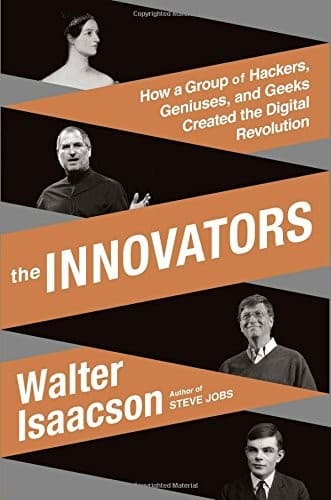
Book details and cover from Google Books.
Ready to read The Innovators?
Get your copy on Amazon, or listen to it on Audible. We earn a commission if you buy through these links.