
We earn a commission if you buy through these links. Learn more
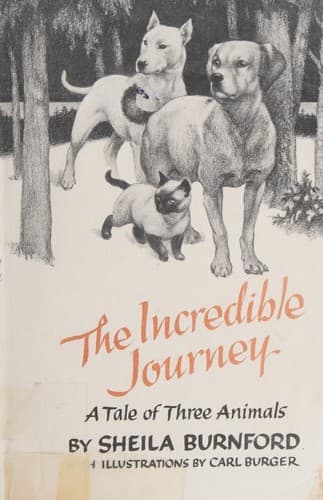
The Incredible Journey
Guide by the Books of the Day editors · Updated · How we write our guides
A mid-century animal adventure that earns its emotion through patient, close-up attention to three pets' loyalty, hardship and instinct.
What Creators Say About The Incredible Journey
2 creators reviewed The Incredible Journey on YouTube between 2013 and 2020, with 160.8K views between them. Their opinions are their own; we picked these reviews, we didn't write them.
What It's About
The Incredible Journey (1961) follows three household animals, Bodger, an older bull terrier, Luath, a young Labrador retriever, and Tao, a Siamese cat, who are left in the care of friends while their family is away. When that arrangement breaks down, the three set out across the Canadian wilderness, determined to find their way home. The premise is simple, but the book's pleasure lies in how the journey is built from small decisions: where to cross water, what to eat, whom to trust, when to rest.
Burnford writes close to the animals without making them cute. Each has a distinct temperament, and their instincts, loyalties and frictions drive the story. Human characters appear in brief encounters, and their kindness or indifference matters a great deal to what happens next. Nature is rendered in precise, sensory detail: rock, weather, hunger, cold. The prose has the earnest, unhurried cadence of a classic adventure from its era.
Reading it is an emotional experience, and sometimes a slow one. The structure favors episodes over momentum, and the sentiment sits close to the surface. Many readers find it absorbing from the first chapters; others find its earnestness hard to sit with. It is short enough to finish in a few evenings and tends to stay with you longer than its length suggests.
Read this if you…
- want a classic animal adventure with real physical hardship and a strong sense of place
- are drawn to stories told from the viewpoint of animals, without talking-animal comedy
- enjoy slow, episodic books where the emotional payoff is earned over many small moments
Skip it if you…
- want fast plotting, twists, or constant suspense
- find sentimental stories about animals hard to read without rolling your eyes
Key Ideas
- 1
Loyalty as the engine of the story
The animals' bonds to each other and to their absent family do most of the narrative work. Their decisions, including the ones that cost them comfort, come from attachment rather than plot convenience. Watching those bonds hold under strain is the book's central pleasure and its main emotional argument.
- 2
Three animals, three temperaments
Burnford gives each animal a recognizable personality: the old dog's stubbornness and dignity, the young dog's eagerness, the cat's independence. These differences create friction and humor along the way. The book works partly because the three never blur into one generic pet.
- 3
Nature as a test, not a backdrop
The wilderness is not scenery to admire from a distance. Water, terrain, weather and food shortages shape every stage of the trip. Burnford keeps the physical stakes concrete, so the travel feels like labor and risk rather than a pleasant walk.
- 4
Humans as brief, uneven presences
People appear in short encounters, and some offer help while others offer indifference or hostility. These moments show the animals' dependence on human decency without turning the book into a lesson about people. The effect is a clear-eyed view of how much fate depends on strangers.
- 5
Sentiment held in check by restraint
The book is openly tender, but its prose mostly avoids melodrama. Burnford tends to state events plainly and let the reader supply the feeling. This restraint is why the book still moves many readers decades after its first publication.
Limitations
Modern readers often note the book's 1960s attitudes, both in its view of human characters and in some assumptions about the natural world. Its animal narration gives the pets human-like feelings and reasoning, which some will find over-sentimental. The episodic structure can feel loose, and the pacing slows in places. It does not offer much on the animals' inner lives beyond what the narrator chooses to convey.
Questions Readers Ask
- Is The Incredible Journey suitable for children?
- Yes, many families read it together, and it is often assigned in schools. The hardships are real, including hunger, injury and danger, but the book is not graphic. Younger readers may need help with the emotional intensity near the end of the journey and with some older language. It works well as a shared read-aloud for ages ten and up.
- How does the book compare to the Disney films?
- The Disney adaptations, including the 1963 film and the 1993 Homeward Bound, keep the basic premise but add humor, voiced animals and a lighter tone. The novel is more restrained and attentive to the physical difficulty of the trip. Readers who loved the films often find the book quieter and more affecting than they expected.
- Is it still worth reading today?
- Yes, if you can accept its era's conventions and its sentimental style. Its strengths are the vivid attention to the animals' bodies and the wilderness, and its clear sense of how dependent we are on other people's goodwill. It is a short book, so the time cost is modest for what it offers.
- Published
- 1960
- ISBN
- 9780340626658
- Difficulty
- beginner
- Category
- Fiction
Book details and cover from Google Books.
Ready to read The Incredible Journey?
Get your copy on Amazon, or listen to it on Audible. We earn a commission if you buy through these links.