
We earn a commission if you buy through these links. Learn more
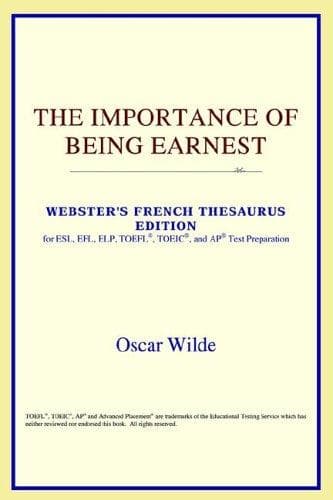
The Importance of Being Earnest
by Oscar Wilde
Wilde's short, glittering comedy of mistaken identity and social pretense, a play that rewards quick reading and even quicker performance, and still the funniest thing about Victorian manners.
What It's About
The Importance of Being Earnest is a play, not a novel, and it is an adult comedy even though some listings file it under children's books. Wilde wrote it in 1895 and subtitled it a trivial comedy for serious people, which tells you most of what you need to know about its attitude. Two young men in London each invent a fictitious persona to escape social obligations, and the plot grows from the consequences of those small lies across a sequence of tightly built scenes.
The experience is mostly one of dialogue. Wilde's lines are epigrams, reversals and sharp put-downs, and much of the pleasure comes from watching characters take the rules of etiquette and romance with complete seriousness while the audience sees how absurd those rules are. Stage directions are sparse, so the text reads quickly, often in a single sitting, but it plays better aloud or on stage than silently on the page.
Expect a light read with a sharper undertow than its frothy surface suggests. The satire of marriage, class and Victorian respectability is real, but Wilde keeps it cheerful. If you want emotional depth or realistic inner lives, you will find the people deliberately thin, and that thinness is part of the joke.
Read this if you…
- enjoy sharp, quotable dialogue and do not mind a plot that runs more on machinery than on psychology
- want a short, funny classic you can finish in an evening
- like satire of manners and class delivered with a light, playful touch
Skip it if you…
- need characters with emotional depth, inner struggle or a strong sense of realism
- are looking for children's fiction or an easy read for a young child, since this is an adult stage comedy aimed at grown audiences
Key Ideas
- 1
Identity as a social performance
The central engine of the comedy is the invented persona. Wilde treats respectability as a costume people wear and swap, and the plot shows how easily a name, a manner or a reputation can stand in for the person underneath. The joke is never that deception is wicked; it is that society has made deception the normal way to get through an afternoon.
- 2
Wit as a weapon
Almost every exchange is built as a polished reversal or a neat paradox, and the characters use these lines to win arguments, score points and protect themselves. Reading the play closely shows how much of Wilde's cleverness is structural: a sentence sets up an expectation and then flips it. The wit is less decoration than the way the characters fight.
- 3
Marriage as a marketplace of status
Courtship in the play is a matter of income, family background and acceptable habits rather than feeling. The formidable interviews conducted by Lady Bracknell expose how these criteria are applied with a straight face. Wilde is mocking a system in which a suitable spouse is chosen like a well-bred piece of property, and he does it without raising his voice.
- 4
Treating trivial things with grave seriousness
A great deal of the humour comes from characters who fuss over small matters, such as food, correct names and the proper timing of a visit, as if they were questions of life and death. The subtitle makes this the explicit method. Wilde's point is that a society which takes its surface rules so seriously has lost track of what actually matters.
Limitations
The characters are types rather than people, and the plot is deliberately contrived, so readers who want psychological development will be disappointed. Much of the satire depends on knowing the Victorian social codes of class, marriage and respectability, which have changed a great deal, so some jokes need a footnote or a little context to land. The play is also far more satisfying in performance than on the page, where the rhythm of the lines can feel thinner than it does on stage.
Questions Readers Ask
- Is The Importance of Being Earnest suitable for children?
- It is listed under children's books in some places, but it is written for adult audiences. Its humour relies on social satire, innuendo about marriage and class, and Victorian manners that younger readers will often miss. Older teenagers with some reading experience may enjoy it, especially with a stage performance or a guide to the context.
- How does it compare to reading Jane Austen?
- Both writers satirise courtship and social position, but Austen gives you a deeper inner life and a slower, more novelistic pace. Wilde is quicker, more openly comic and more interested in dialogue than in interior thought. If you enjoy Austen's social wit, you will likely find Wilde's epigrams a fast, sharp contrast.
- Published
- 1893
- ISBN
- 9781495286261
- Difficulty
- beginner
- Category
- Children's Books
Book details and cover from Google Books.
Ready to read The Importance of Being Earnest?
Get your copy on Amazon, or listen to it on Audible. We earn a commission if you buy through these links.